
7 Key Strategies for Competitive Positioning Marketing 2026




In 2026, the race for market leadership in B2B SaaS and enterprise software is more intense than ever. Companies are rewriting their playbooks as AI, Agentic Automation, and unified go to market execution disrupt old rules and create new opportunities.
To thrive, organizations must embrace competitive positioning marketing as a strategic growth lever. This article reveals 7 proven strategies that empower you to accelerate pipeline, boost ARR, and drive alignment across product, marketing, and sales.
Are you ready to unlock a measurable advantage? Dive in, discover the blueprint for outpacing rivals, and take action to future proof your market position.
The Evolving Landscape of Competitive Positioning in 2026
The B2B SaaS and enterprise software markets are undergoing seismic shifts. Digital transformation, data-driven decisions, and especially Agentic AI are redrawing the competitive map. Today, competitive positioning marketing is no longer static. It requires rapid adaptation to stay ahead.
Buyers now expect hyper-personalized, seamless experiences across every touchpoint. Their journeys have grown longer, more complex, and demand tailored messaging at each stage. In fact, recent studies show that 73% of SaaS buyers engage with at least five channels before making a decision, and 61% expect AI-powered recommendations.
| Trend | 2026 Projection |
|---|---|
| Global SaaS Market Growth | $374B (CAGR 18%) |
| AI Adoption in SaaS | 79% of firms |
| ABM/Personalization Focus | 68% of GTM budgets |
As global markets expand, traditional industry boundaries blur. Companies must align product, marketing, and sales for unified GTM execution. For example, leading SaaS firms use Agentic AI to monitor competitors, personalize offers, and pivot strategies in real-time. One enterprise leveraged Agentic Automation to cut response times by 40%, outpacing rivals in both pipeline growth and ARR.
This urgency to evolve is clear. Strategies that worked yesterday may be obsolete tomorrow. To master Positioning in B2B marketing, organizations must embrace continuous innovation, cross-functional alignment, and the power of Agentic AI. Only then can competitive positioning marketing deliver the measurable outcomes modern markets demand.
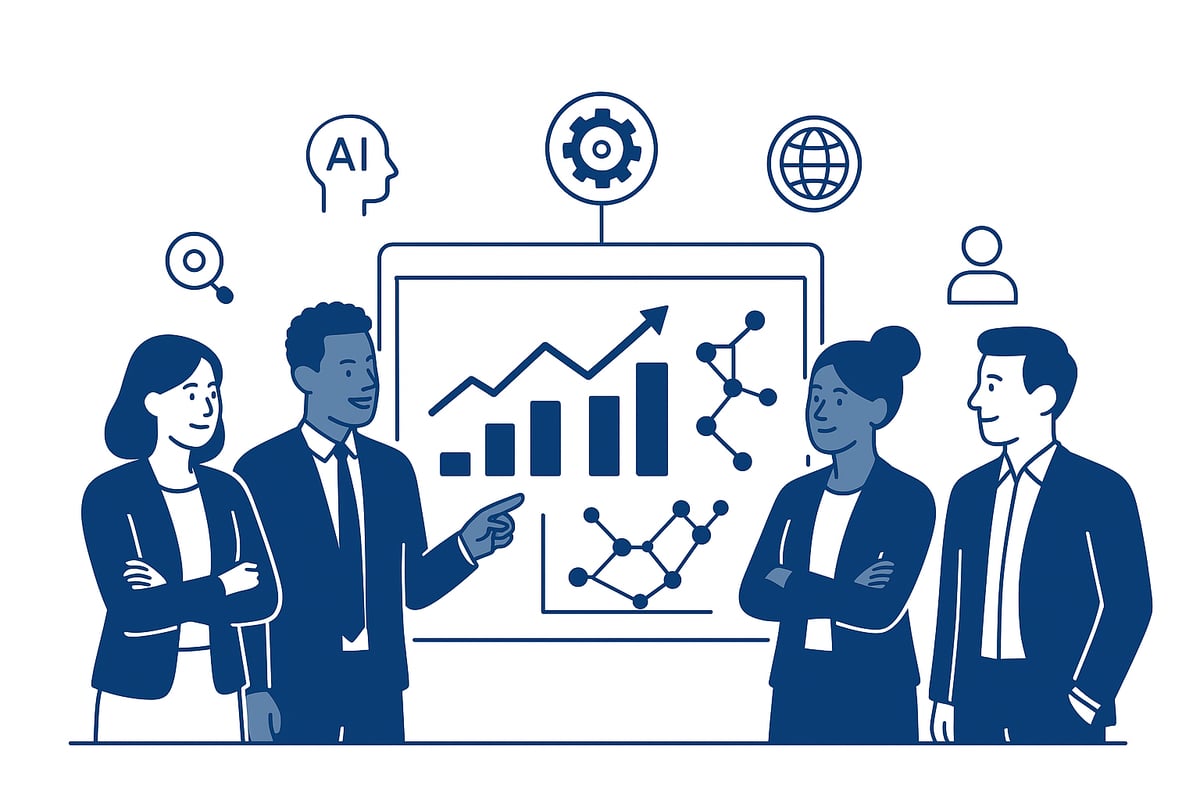
7 Key Strategies for Competitive Positioning Marketing 2026
To stand out in the 2026 B2B SaaS and enterprise software race, companies must evolve their competitive positioning marketing playbooks. The following seven strategies give you a roadmap for measurable growth, pipeline acceleration, and cross-functional alignment. Each is designed for rapid adaptation, leveraging the latest in Agentic AI, automation, and unified GTM execution.

1. Data-Driven Market Segmentation and ICP Refinement
Modern competitive positioning marketing starts with a crystal-clear Ideal Customer Profile, built on real-time data. AI and advanced analytics empower teams to micro-segment audiences, predict buying intent, and focus resources on high-propensity accounts.
For example, leading SaaS providers use machine learning to identify fast-growing midsize tech firms showing intent signals, quickly adapting their outreach. Dynamic ICPs allow for continuous market adaptation and smarter spend.
Recent trends show that companies refining ICPs monthly see up to 20% higher win rates. For a deeper dive, explore this B2B SaaS marketing strategy guide on segmentation and competitive differentiation.
2. Unified Value Proposition: Aligning Product, Marketing, and Sales
A single, differentiated value proposition, echoed across every GTM touchpoint, is the backbone of competitive positioning marketing. When product, marketing, and sales speak the same language, trust builds and sales cycles shorten.
Enterprises like Atlassian have fueled ARR growth by aligning product features directly to buyer pain points. They use frameworks mapping features to outcomes, ensuring every pitch resonates.
Industry data shows that organizations with aligned sales and marketing see 36% higher customer retention and 38% faster win rates. Unified value messaging is not just internal housekeeping, it is a growth engine.
3. Agentic AI and Automation for Competitive Intelligence
Agentic AI is redefining competitive positioning marketing by making intelligence proactive. Imagine AI agents that monitor competitors in real time, flag pricing changes, and recommend instant offer tweaks.
SaaS leaders now deploy Agentic AI to automate competitive tracking, enabling dynamic pricing and offer adjustments. This has led to measurable boosts in win/loss ratios and pipeline velocity.
Integrating AI-driven insights into GTM playbooks ensures teams are never caught off guard. In 2026, Agentic Automation will be a must-have for dynamic, data-driven market moves.
4. Outcome-Based Positioning and Value Engineering
Outcome-based positioning shifts the focus from features to measurable results, a critical evolution in competitive positioning marketing. Value engineering helps quantify and communicate ROI, turning abstract benefits into hard numbers.
For example, a SaaS vendor proved they could cut customer churn by 30%, directly impacting ARR. Their sales collateral included ROI calculators and case studies, making value tangible.
Recent research reveals that 74% of B2B buyers prefer vendors who can demonstrate business impact. Building outcome-centric content and enablement tools is now essential for winning high-stakes deals.
5. Multi-Channel Personalization and Account-Based Experiences
Engagement soars when every buyer interaction feels tailored. Multi-channel orchestration and 1:1 personalization are now pillars of competitive positioning marketing, especially for enterprise deals.
Account-Based Marketing (ABM) strategies leverage AI to customize content, offers, and outreach for each target account. For instance, one SaaS company saw a 30% lift in deal velocity by personalizing demos and follow-ups.
Collaboration between sales and marketing ensures seamless handoffs and unified experiences. ABM and personalization now deliver 20% higher ROI than traditional tactics, according to recent industry statistics.
6. Continuous Feedback Loops and Iterative Positioning
Agility is the secret weapon in competitive positioning marketing. Real-time feedback from sales teams, customers, and market data feeds rapid iteration.
Modern SaaS firms use automated tools to capture feedback at scale. When messaging or positioning falls flat, updates are made within days, not quarters.
This iterative approach has led to double-digit improvements in win rates and customer retention. The link between feedback loops and rapid GTM adaptation is now undeniable.
7. Enablement, Playbooks, and Operational Dashboards
Empowering GTM teams with the right resources is the linchpin of competitive positioning marketing. Enablement materials and competitive playbooks give teams the confidence to execute and adapt.
Operational dashboards track pipeline health, ARR, and competitive metrics in real time. Organizations that invest in playbooks see faster ramp times and more consistent execution.
Best practices include updating enablement in lockstep with market shifts. For actionable guidance, see these sales enablement content strategies for building high-impact playbooks. Measuring enablement effectiveness ensures continuous optimization and higher deal velocity.
The Role of Agentic AI in Future-Proofing Competitive Positioning
Agentic AI is rapidly transforming competitive positioning marketing by bringing intelligent automation, context awareness, and autonomous decision-making to B2B SaaS and enterprise software. Unlike traditional automation, Agentic AI can independently assess market signals, competitor moves, and buyer intent, then trigger tailored GTM actions in real time. According to Agentic AI in B2B Marketing, leading brands now use Agentic Automation to design adaptive campaigns, optimize offers, and dynamically adjust value messaging.
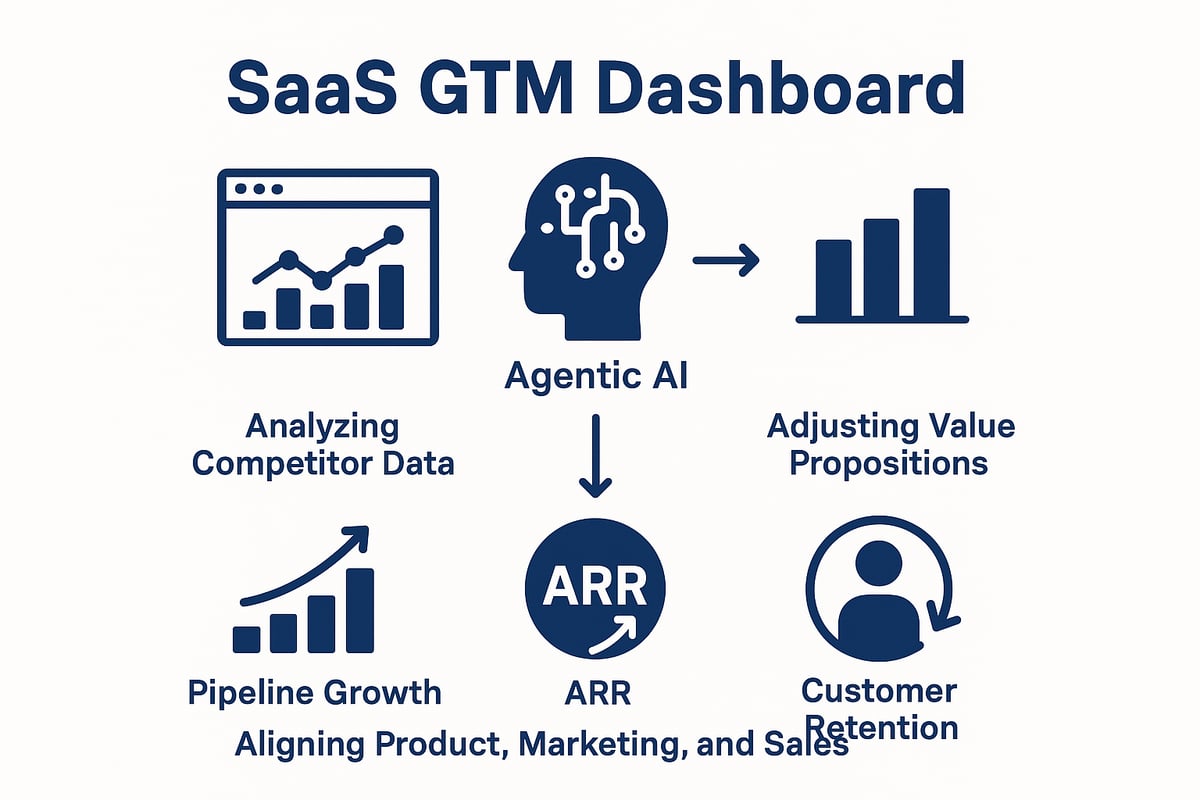
Real-World Impact: Pipeline, Velocity, Retention
SaaS companies leveraging Agentic AI in their competitive positioning marketing are seeing measurable results. For example, organizations embedding Agentic AI into GTM workflows report faster pipeline acceleration, reduced sales cycle times, and higher customer retention. Gartner predicts that by 2028, 60 percent of brands will use Agentic AI for personalized customer interactions, a shift that directly impacts win rates and market share (Gartner on Agentic AI Adoption).
- Accelerated deal velocity through real-time offer adjustments
- Improved ARR via dynamic pricing and segmentation
- Enhanced retention due to AI-personalized onboarding and support
Embedding Agentic AI: Steps and Best Practices
To future-proof competitive positioning marketing, GTM teams should:
- Integrate Agentic AI tools for continuous competitor monitoring and data analysis
- Align AI-driven insights with unified product, marketing, and sales playbooks
- Establish operational dashboards to track AI impact on pipeline and ARR
- Foster a feedback culture for ongoing AI model refinement
Adopting Agentic AI requires cross-functional alignment, robust data governance, and continuous learning. By embracing these practices, organizations can secure a lasting edge in the ever-evolving B2B SaaS landscape.
As you’ve seen throughout these seven strategies, getting your competitive positioning right is less about chasing the latest buzzwords and more about creating real, measurable impact—pipeline acceleration, ARR growth, and truly unified go to market teams. Imagine your product, marketing, and sales efforts moving in perfect sync, guided by data and real feedback, just like the SaaS founders I’ve worked with who transformed uncertainty into repeatable wins. If you’re ready to turn insight into action and map out what your own 2026 positioning could look like, let’s spark that conversation together—Book Your Personal Intro Call.

Latest From
The Blog
Go To Market Strategy Consulting Guide For 2025 Success

Go To Market Strategy McKinsey Guide For Success 2025
.jpg)
Crossing the Enterprise Chasm: A Practical Guide to Sales-Led Growth (SLG)

Let's Build The Future Together
