
Essential Guide to Marketing Go to Market Strategy 2026




As 2026 approaches, the pressure to future-proof your marketing go to market strategy has never been greater. B2B SaaS and enterprise software markets are evolving at breakneck speed, with buying cycles, decision makers, and competition shifting rapidly.
Today’s buyers expect more than just information—they demand personalized engagement, seamless experiences, and fast value realization. AI-powered automation and Agentic AI are rewriting the rules of engagement, transforming how teams orchestrate every stage of go to market.
This essential guide gives you the frameworks and insights to master GTM for scalable pipeline and revenue growth. Inside, you’ll discover:
- What defines a modern GTM strategy
- The critical components for 2026 success
- How to align product, marketing, and sales for unified growth
- The impact of Agentic AI on GTM execution
- A step-by-step blueprint to build your go to market plan
Let’s equip you with the tools to build a high-impact marketing go to market strategy—and turn 2026’s challenges into opportunities.
Understanding Marketing Go-to-Market Strategy: Core Concepts
A marketing go to market strategy is more than a product launch plan. It is a unified, cross-functional approach that connects product, marketing, sales, and customer success into a single engine for introducing and scaling solutions in chosen markets. Unlike traditional marketing strategies, which often focus on long-term brand building or short-term campaigns, GTM strategies are built for speed, adaptability, and direct revenue impact.
In B2B SaaS and enterprise software, the stakes are high. Buyers are better informed and decision cycles are faster. Markets are crowded and competitive. That is why a modern marketing go to market strategy must be agile, data-driven, and laser-focused on measurable business outcomes.
Core pillars of an effective GTM strategy include:
- Market segmentation: Identify and prioritize the right buyers and verticals.
- Positioning and messaging: Tailor your value proposition to address specific pain points.
- Enablement: Equip teams with tools and content for every buyer stage.
- Revenue operations: Align systems and metrics for unified growth.
Proven frameworks like TAM/SAM/SOM, ideal customer profiles (ICPs), and unified sales and marketing funnels help guide decisions and resource allocation. For example, SaaS startups that pivot from product-problem fit toward scalable ARR often rely on precise ICPs and dynamic segmentation to win in new markets.
According to ZoomInfo, 60% of Fortune 100 companies now use data-driven GTM platforms. The next evolution is already underway, with AI and Agentic AI automation orchestrating real-time buyer engagement and pipeline management. For a deeper look at what drives GTM success and common pitfalls, see Why Go-to-Market Strategies Fail.

Key Components of a High-Impact GTM Strategy for 2026
Building a high-impact marketing go to market strategy for 2026 demands a blend of data, cross-team unity, and relentless focus on buyer needs. Each component below forms a pillar for scalable B2B SaaS success.

Market Intelligence & Segmentation
Precision in market sizing is essential. Use tiers like TAM, SAM, SOM, and PAM to map opportunities and avoid wasted resources.
AI-powered tools now allow real-time segmentation based on behavioral signals. For example, a SaaS company can adjust its ideal customer profile (ICP) on the fly as new buying patterns emerge.
ZoomInfo’s tiered approach helps teams prioritize the highest-value segments and stay agile in competitive markets.
Value Proposition & Product Positioning
Craft messaging that speaks directly to your buyer personas. Align every product feature with a real market pain point or a competitor’s gap.
Consider the shift of AI-powered SaaS platforms repositioning for enterprise buyers—this often means rethinking both benefits and proof points. For a deeper dive, see this Marketing and Positioning Strategy guide.
Test and refine your story using AI sentiment analysis to ensure your value proposition lands with each audience.
Cross-Functional Alignment
High-performing teams break down silos. Integrate product, marketing, sales, and customer success into a single GTM engine.
Shared KPIs and unified execution replace disconnected goals. According to a recent ZoomInfo survey, 48 percent of sales leaders say alignment is the number one GTM challenge.
Agentic AI can help orchestrate workflows, ensuring feedback loops and accountability across all roles.
Channel & Distribution Strategy
Evaluate every path to your customer—direct sales, partners, e-commerce, and digital channels.
Today’s digital-first buyers expect seamless experiences. SaaS leaders often combine self-serve and enterprise sales to maximize reach while mitigating channel conflict.
Monitor channel performance and adapt quickly as buyer preferences shift.
Pricing & Packaging Models
Select pricing models that fit both the market and your growth goals. Trends include:
| Model | Description | Impact on ARR |
|---|---|---|
| User-based | Pay per user | Predictable, scalable |
| Usage-based | Pay for what you use | Aligns with customer ROI |
| Tiered | Feature/volume bundles | Supports upsell/cross-sell |
| Hybrid | Combination models | Flexibility for growth |
| Freemium | Free entry, paid upgrades | Fuels pipeline growth |
Freemium and tiered approaches are fueling SaaS adoption, making them a must-consider in any marketing go to market strategy for 2026.
Step-by-Step Guide: Building Your 2026 GTM Strategy
Building a future-ready marketing go to market strategy requires precision, agility, and collaboration. The following five-step guide blends proven frameworks with next-generation AI and automation, ensuring your approach is actionable and scalable for B2B SaaS and enterprise markets. For hands-on templates and detailed planning steps, explore the GTM Plan Template and Steps.

Step 1: Market Research & ICP Definition
Start by quantifying your addressable market with AI-powered analytics. Define your Ideal Customer Profile (ICP) using real-time product usage and buying intent signals.
- Segment TAM, SAM, SOM, and prioritize high-fit accounts
- Leverage Agentic AI to identify emerging market trends
- Example: A SaaS startup pivots ICP focus after discovering new user patterns in their product data
A robust marketing go to market strategy begins with precise targeting.
Step 2: Crafting Messaging & Positioning
Develop messaging that resonates with each segment’s pain points and decision criteria. Use AI sentiment analysis to test and refine your positioning against the competition.
- Map key benefits to buyer personas
- Adjust based on AI-driven feedback and competitive shifts
- Example: An enterprise software company updates messaging after competitor analysis reveals new market needs
This step ensures your marketing go to market strategy stands out.
Step 3: Channel Selection & Enablement
Choose the best channels based on where your buyers engage, whether direct, digital, or partner-driven. Equip teams with unified playbooks and enablement content for consistent execution.
- Evaluate self-serve, sales-led, and partner channels
- Align sales and marketing on shared KPIs
- Example: Coordinated digital and field sales drive higher feature adoption
Channel strategy is central to a winning marketing go to market strategy.
Step 4: Pricing Strategy & Revenue Model
Select a pricing model that matches customer value and evolving market expectations. Test multiple tiers using A/B experiments to maximize conversion and ARR.
- Compare flat-rate, usage-based, and hybrid models
- Use data to refine value-based pricing
- Example: SaaS firm shifts to usage-based pricing to unlock new ARR streams
Pricing innovation accelerates growth in any marketing go to market strategy.
Step 5: Launch Planning & Execution
Orchestrate a cross-functional launch with clear milestones, unified KPIs, and agile feedback loops.
- Build a detailed timeline involving product, sales, and marketing
- Integrate Agentic AI for real-time launch optimization
- Example: Six-month SaaS launch roadmap for a new vertical with continuous learning cycles
A disciplined launch ensures your marketing go to market strategy delivers pipeline and revenue impact.
Leveraging Agentic AI and Automation in GTM Execution
Agentic AI is transforming how companies execute their marketing go to market strategy by introducing autonomous agents that can manage complex workflows with speed and precision. Instead of relying on manual tasks or simple automation, Agentic AI empowers GTM teams to orchestrate campaigns, qualify leads, and personalize outreach at scale.
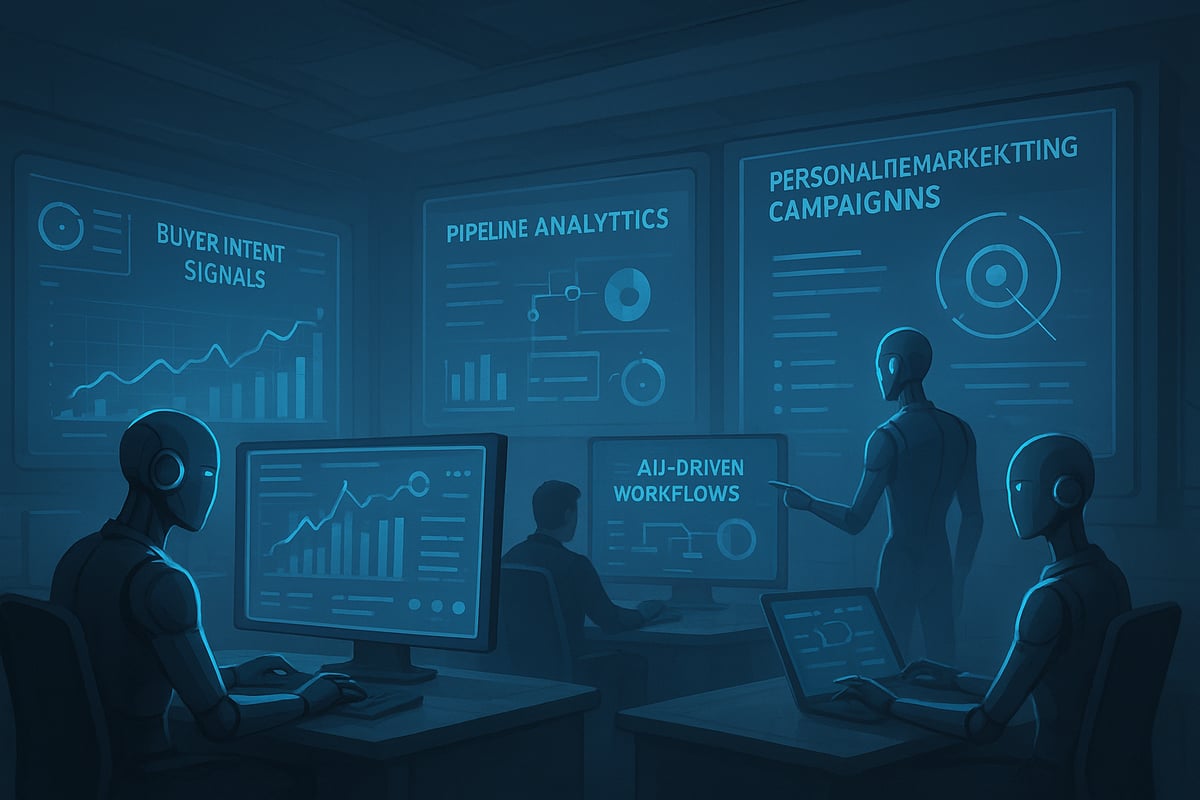
Key use cases for Agentic AI in GTM execution:
- Real-time detection of buyer intent and market signals.
- Automated qualification and routing of leads to sales teams.
- Personalized outreach and nurturing sequences that adapt based on AI insights.
- Pipeline management, forecasting, and reporting with minimal human intervention.
For example, a SaaS provider deploying Agentic AI saw AI agents automatically qualify inbound leads, assess fit using data, and hand off only high-potential accounts to sales. This not only accelerated response times but also improved conversion rates.
According to a recent industry survey, 70% of B2B buyers will expect AI-driven personalization by 2026. To stay ahead, companies are integrating Agentic AI as a core pillar of their marketing go to market strategy. For a deeper dive into the role of Agentic AI in GTM and sales, see Agentic AI in B2B Sales.
However, the benefits of Agentic automation come with the need for human oversight and robust data governance. Ensuring data quality and maintaining ethical standards are essential as AI agents gain autonomy. Best practices include regular audits, collaborative workflows, and clear escalation paths.
Looking forward, Agentic AI will be a true competitive differentiator. Companies that blend automation with expert human judgment will unlock scalable growth, pipeline velocity, and market leadership. Explore more on emerging trends in B2B SaaS, including AI-powered GTM, in B2B SaaS Marketing Trends 2026.
Aligning Product, Marketing, and Sales for Unified Growth
Achieving unified growth in SaaS and enterprise software demands more than siloed excellence. True momentum comes when product, marketing, and sales move as one, driven by a shared marketing go to market strategy. Why? In today’s fast-paced market, disconnected teams mean missed signals, slower pipeline, and fragmented customer experiences.
Alignment starts with unified KPIs and shared dashboards. These frameworks ensure every team, from product to sales, is measured against the same revenue and customer success outcomes. As the SVP of Marketing at ZoomInfo puts it, “True integration is the goal.” Revenue operations (RevOps) brings this to life, breaking down barriers and enabling real-time data flow across functions.
For example, xtype.io transformed its growth trajectory by shifting from isolated teams to a fully integrated GTM squad. The result: a 60% increase in pipeline within months. This kind of success is driven by interim leadership that champions alignment, plus enablement playbooks that keep teams focused and agile.
Agentic AI now accelerates this process, automating handoffs and surfacing cross-functional insights instantly. Continuous feedback loops and rapid iteration ensure the marketing go to market strategy stays relevant as buyer behavior shifts. For a deeper dive into structuring cross-functional teams, explore Go-to-Market Team Structure.
Unified teams don’t just grow faster, they build lasting market advantage—delivering measurable gains in pipeline velocity, ARR, and lifetime value.
You’ve just explored the ins and outs of building a future proof go to market strategy for 2026 from aligning your product marketing and sales teams to harnessing the power of Agentic AI. I know every founder and growth leader faces unique challenges on this journey—I’ve seen startups hit roadblocks they never expected and others soar after finding the right alignment. If you’re ready to turn these insights into real results and want a seasoned partner to help you connect the dots for scalable growth let’s chat about your specific goals. Book Your Personal Intro Call

Latest From
The Blog
Go To Market Strategy Consulting Guide For 2025 Success

Go To Market Strategy McKinsey Guide For Success 2025
.jpg)
Crossing the Enterprise Chasm: A Practical Guide to Sales-Led Growth (SLG)

Let's Build The Future Together
