
RevOps Consulting: Build Revenue Engines That Scale




Your CRO just told you pipeline coverage is at 2.1x. Marketing swears they're hitting MQL targets. Sales insists lead quality is garbage. Customer Success sees churn creeping up in EMEA but can't get anyone to listen. This isn't a people problem. It's a revenue operations problem. And it's costing you 20-40% of potential ARR growth.
Why B2B SaaS Companies Turn to RevOps Consulting
Most $3M-$75M ARR companies inherit their GTM structure from earlier growth stages. What worked at $5M breaks at $15M. By $30M, you're running three disconnected revenue engines with conflicting metrics, duplicated tools, and zero shared truth about what's actually working.
RevOps consulting exists to fix this structural misalignment. Unlike traditional go-to-market consulting, which often focuses on strategy decks, revops consulting gets into the operational weeds: your tech stack, data flows, attribution models, and cross-functional handoffs.
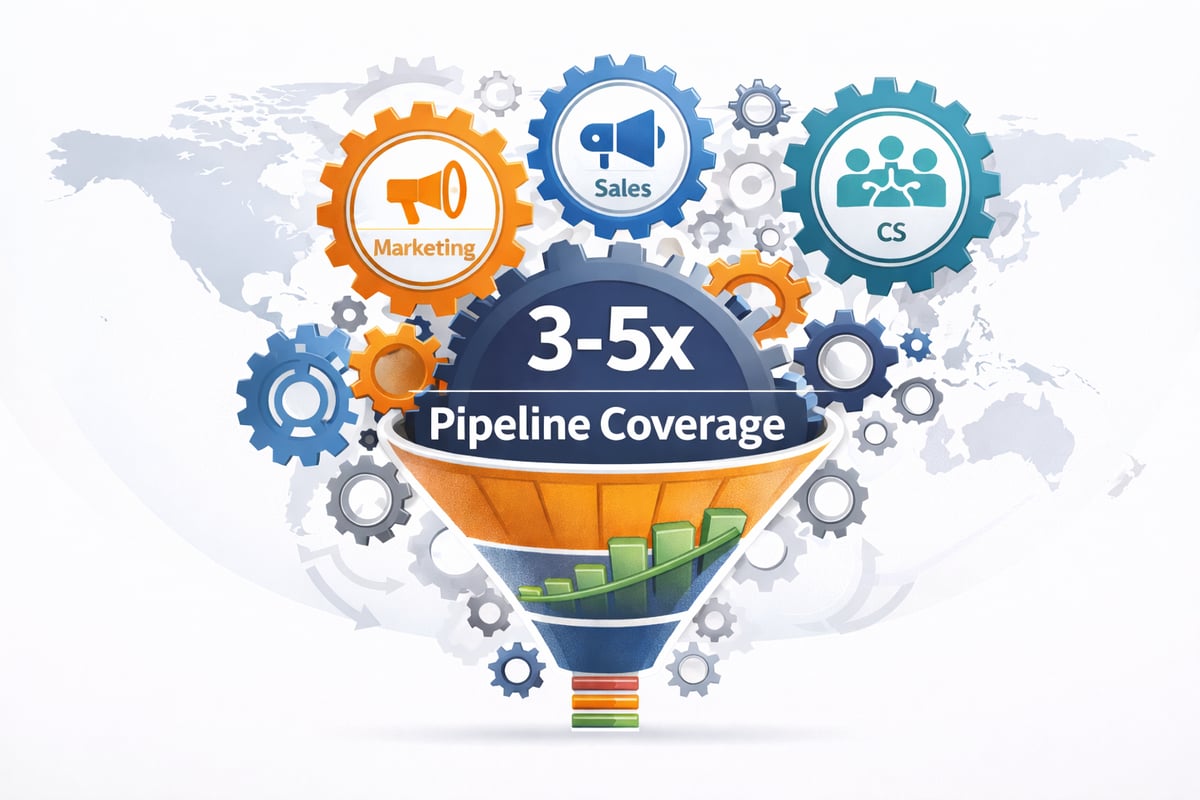
The benchmark for healthy pipeline coverage sits between 3-5x. If you're below 3x, you're one deal slip away from missing the quarter. Above 5x often signals qualification problems or unrealistic sales capacity planning.
The Core RevOps Consulting Engagement Model
Effective revops consulting tackles four operational pillars simultaneously:
- Data architecture and system integration connecting CRM, marketing automation, product analytics, and success platforms
- Process standardization across lead-to-cash workflows, ensuring consistent execution from SDR to renewal
- Metrics alignment establishing shared definitions for pipeline stages, conversion rates, and revenue attribution
- Cross-functional governance creating forums where sales, marketing, and CS leaders make decisions together

The best RevOps consulting engagements don't just audit and recommend. They embed with your team to execute changes, test hypotheses, and iterate based on actual conversion data.
The Revenue Operations Maturity Assessment
Before hiring external help, assess where your organization stands. Most PE-backed teams we work with fall into one of three maturity levels.
| Maturity Stage | Characteristics | Typical ARR Range | Primary Pain Point |
|---|---|---|---|
| Reactive | Siloed tools, manual reporting, finger-pointing between teams | $3M-$10M | No single source of truth |
| Developing | Integrated CRM, basic attribution, quarterly planning cadence | $10M-$30M | Inconsistent execution across regions |
| Optimized | Unified data model, predictive analytics, continuous improvement culture | $30M-$75M+ | Scaling complexity, retention focus |
Companies in the Reactive stage need foundational system integration and process documentation. Developing organizations benefit most from cross-functional alignment frameworks and standardized playbooks. Optimized teams typically engage consultants for specific challenges like multi-product attribution or enterprise expansion motions.
The gap between Reactive and Optimized represents 25-40% difference in sales cycle velocity and win rates, based on our work across US and EMEA markets.
Building Your RevOps Technology Stack
Every B2B SaaS company asks the same question: which tools do we actually need? The answer depends on your GTM motion, but the core stack remains consistent.
Essential platforms:
- CRM (Salesforce, HubSpot) as system of record
- Marketing automation (Marketo, Pardot, HubSpot) for demand generation
- Conversation intelligence (Gong, Chorus) for deal insights
- Revenue intelligence (Clari, InsightSquared) for forecasting
Common mistakes:
- Buying tools before defining processes
- Over-customizing Salesforce to match broken workflows
- Ignoring data quality at the contact/account level
- Skipping integration testing between platforms
The right revops consulting partner helps you rationalize your tech stack before adding complexity. We've seen $20M ARR companies running 40+ tools with less than 30% utilization. That's $200K+ in annual waste plus operational drag.

Regional GTM Complexity and RevOps Solutions
Expanding from US to EMEA or DACH markets exposes every crack in your revenue operations foundation. Different buying cycles, compliance requirements (GDPR), language localization, and currency handling multiply operational complexity.
Smart revenue operations consulting addresses regional expansion through:
- Unified data models that accommodate multiple currencies, tax structures, and legal entities
- Territory and quota planning that reflects market maturity differences between regions
- Localized process documentation while maintaining global standards for pipeline stages and qualification criteria
- Regional reporting dashboards that roll up to consolidated executive views
A $15M ARR company selling in both California and Germany needs different lead scoring models, content strategies, and sales methodologies. But pipeline coverage targets, conversion benchmarks, and CAC payback expectations should remain consistent.
The Sales-Led to PLG Transition Challenge
Product-led growth introduces new operational complexity that traditional sales-led organizations struggle to handle. Your CRM wasn't built for 10,000 self-serve signups monthly. Your attribution model breaks when users convert without ever talking to sales.
This transition requires revops consulting expertise in:
- Dual-track pipeline management separating high-touch enterprise from low-touch product-qualified leads
- Hybrid conversion models that identify when PLG users need sales intervention
- Usage-based scoring combining product signals with traditional firmographic data
- Customer journey mapping across self-serve, sales-assisted, and enterprise paths
Companies attempting this shift typically see 6-12 months of operational chaos without experienced guidance. GTM Assessment & Operating System Design helps B2B SaaS leaders architect systems that support multiple motions simultaneously, ensuring you don't sacrifice existing revenue while building new channels.
Metrics That Matter in Revenue Operations
Every RevOps consultant claims to be data-driven. Few actually build measurement frameworks that change behavior. The difference lies in metric selection and governance.
Executive dashboard metrics:
| Metric | Benchmark | Leading or Lagging | Review Cadence |
|---|---|---|---|
| Pipeline Coverage | 3-5x | Leading | Weekly |
| Sales Cycle Length | 45-120 days (segment dependent) | Lagging | Monthly |
| Win Rate | 20-35% | Lagging | Monthly |
| CAC Payback Period | <12 months | Lagging | Quarterly |
| Net Revenue Retention | >100% (110%+ excellent) | Lagging | Quarterly |
Operational health metrics:
- Lead response time (target: <5 minutes for inbound)
- Opportunity stage conversion rates (compare to historical baseline)
- Sales activity metrics (calls, demos, emails per rep)
- Marketing contribution to pipeline (40-50% target for healthy mix)
- Customer health scores and expansion pipeline
The best practices in revenue operations emphasize metric alignment over metric volume. Three well-governed KPIs trump fifteen that nobody trusts.

Execution Discipline and Change Management
Most RevOps initiatives fail during implementation, not design. You hire consultants who deliver a beautiful operating system blueprint. Then it sits in a shared drive while teams revert to old habits.
Successful revops consulting includes execution support:
- Pilot programs that test changes with one team before company-wide rollout
- Training delivery customized by role (SDR, AE, CSM, operations analyst)
- Weekly stand-ups during the first 90 days to troubleshoot adoption issues
- Metrics dashboards that make new processes visible and accountable
We've learned this from deploying GTM operating systems across PE-backed portfolios: documentation doesn't drive change, embedded execution does. The consultant who designs your process should help your team run it until it becomes muscle memory.
Change management in revenue operations requires CRO-level sponsorship, cross-functional working groups, and consequences for non-compliance. Otherwise, your Salesforce fields stay empty and your attribution reports remain fiction.
When to Bring in RevOps Consulting
Timing matters. Bring in consultants too early and you're optimizing processes that will completely change in six months. Wait too long and operational debt compounds into organizational paralysis.
Clear trigger events:
- Preparing for Series B/C funding rounds where investors scrutinize revenue efficiency
- PE acquisition requiring rapid profitability improvements and operational standardization
- Missing quarterly targets despite increased sales headcount and marketing spend
- Expanding into new regions (EMEA, DACH, APAC) from US home market
- Shifting from sales-led to PLG or adding enterprise motion to product-led foundation
Companies between $10M-$30M ARR typically see the highest ROI from RevOps consulting engagements because they have enough complexity to justify dedicated operations but lack internal expertise to build it properly.
The wrong time to hire RevOps help: during active leadership transitions, before you've validated product-market fit, or when you're not willing to change how teams currently operate.
Building Internal RevOps Capability
Should you hire a full-time RevOps leader or use fractional consulting? Most $15M-$40M ARR companies need both.
The fractional advantage:
- Access to pattern recognition across dozens of similar companies
- No ramp time understanding B2B SaaS revenue models
- Objective perspective unconstrained by internal politics
- Flexibility to scale up/down based on project needs
When to hire full-time:
- Consistent 30+ hours weekly of operational work
- Need for deep institutional knowledge and relationship building
- Budget for $150K+ compensation plus supporting analyst headcount
The optimal approach combines external fractional CMO and GTM leadership to design and launch your revenue operations system, then transition execution to internal hires once processes stabilize.
Avoid hiring junior operations analysts and expecting them to architect enterprise-grade RevOps. That's a $200K mistake that costs you 12 months of momentum.
Revenue operations consulting transforms fragmented sales, marketing, and success functions into unified growth engines with predictable output. The companies that win in 2026 will be those that invest in operational excellence alongside product innovation and market expansion. GTM Consult works alongside B2B SaaS leadership teams to design and execute revenue operations systems that deliver 3-5x pipeline coverage, higher conversion rates, and scalable growth across US, EMEA, and DACH markets.

Latest From
The Blog

Go To Market Strategy Consulting Guide For 2025 Success


Go To Market Strategy McKinsey Guide For Success 2025
.jpg)
Crossing the Enterprise Chasm: A Practical Guide to Sales-Led Growth (SLG)

Let's Build The Future Together
