

B2B Product Marketing Guide: Strategies for 2026 Success




In 2026, B2B product marketing is at a turning point. AI-driven automation, especially Agentic AI, is reshaping how SaaS and enterprise software companies reach and convert customers. Buyers expect seamless, personalized journeys and unified go-to-market execution.
This guide offers proven strategies to help you align product, marketing, and sales for measurable growth. Discover how to harness Agentic AI, optimize your GTM approach, and apply tactics that drive pipeline and annual recurring revenue.
Are you ready to adapt and thrive in the new era of b2b product marketing? Dive in to unlock scalable growth for your organization.
The Evolving Landscape of B2B Product Marketing in 2026
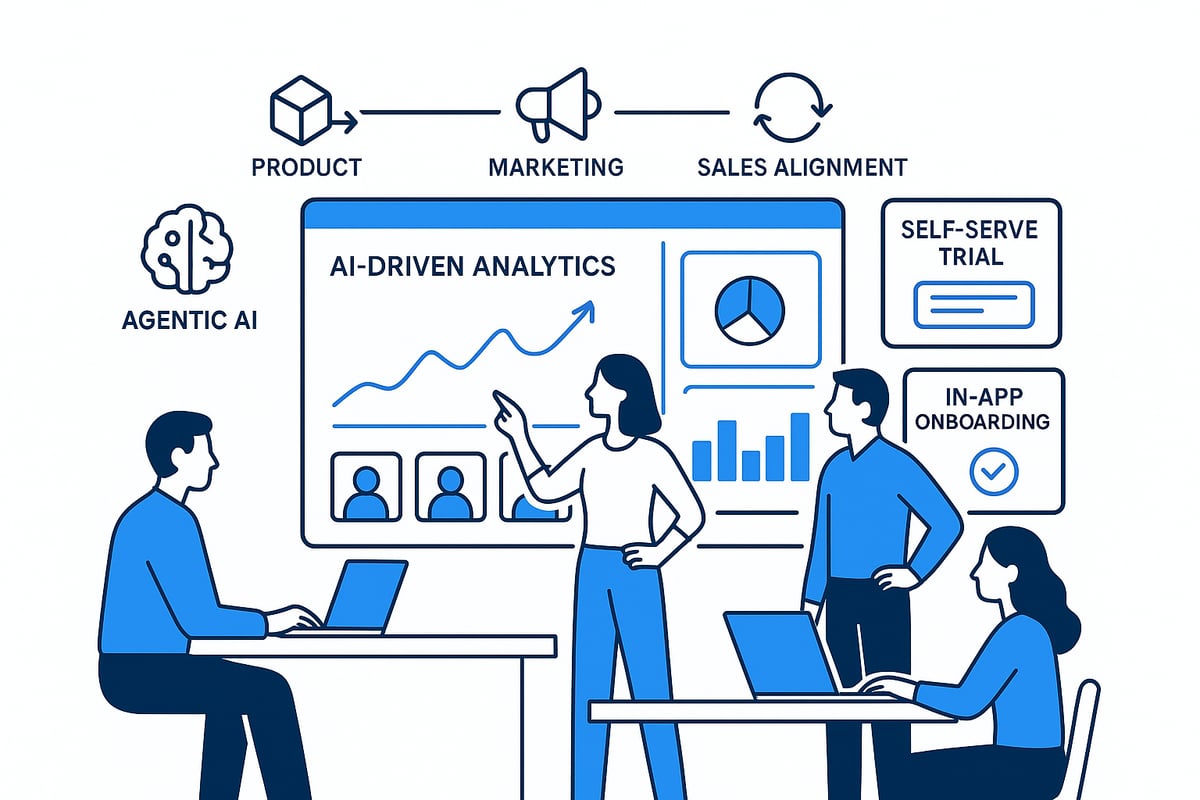
B2B product marketing is undergoing a seismic shift as digital transformation and AI reshape how enterprise buyers discover and adopt solutions. In 2026, Agentic Automation drives personalized experiences and smarter decision-making, while buyer journeys become more complex and self-directed.
Today’s buyers expect tailored, AI-powered interactions at every touchpoint. According to Userpilot, 70% of B2B buyers now demand this level of personalization. Product, marketing, and sales teams are breaking down silos, forming unified growth functions that align on pipeline goals and market positioning.
Key trends include:
- Rapid adoption of product-led growth and hybrid go-to-market models in SaaS.
- Self-serve trials and in-app onboarding empowering buyers to explore products on their terms.
- Data-driven strategies guiding every stage of the customer lifecycle.
- Larger, more complex buying committees and longer sales cycles in enterprise deals.
Leading SaaS companies are leveraging Agentic AI to automate customer segmentation and orchestrate personalized journeys, accelerating pipeline and ARR. For a deeper dive, explore how AI agents are transforming B2B marketing and sales by automating processes and enhancing personalization.
In this fast-evolving landscape, b2b product marketing success hinges on embracing AI, fostering cross-team alignment, and building agile, data-driven growth engines.
Core Pillars of a Modern B2B Product Marketing Strategy
To thrive in the world of b2b product marketing, companies must build on three essential pillars. These foundations—market research, positioning, and unified execution—enable SaaS and enterprise software brands to drive growth with precision. Let’s break down each pillar and see how today’s leaders are raising the bar.

Strategic Market & Customer Research
In b2b product marketing, deep market and customer insight is your compass. AI-powered analytics now let teams build detailed ICPs and personas that reflect changing enterprise needs. Competitive mapping tools show exactly where your product stands, helping you carve a unique position.
- Leverage real-time market data to spot trends and shifts early.
- Use Agentic AI for segmentation and opportunity discovery.
- Continuously refine your research as buyer behaviors evolve.
For step-by-step frameworks, explore this Product marketing strategy guide.
Product Positioning & Messaging for 2026
Winning b2b product marketing today means delivering messaging that truly resonates. Data-driven value propositions, tailored to each segment, set leading brands apart. Listen closely to customer feedback and let it guide your narrative.
- Test messaging with real users using AI tools.
- Update positioning as the market shifts.
- Take inspiration from SaaS leaders like Broadcom, who saw pipeline growth soar after a bold rebrand.
Every message must reinforce your product’s unique edge.
Unified Go-to-Market Execution
Alignment is now non-negotiable. Integrating product, marketing, and sales into a single growth function ensures every effort moves the needle. Use data-driven KPIs that tie each activity to pipeline and ARR.
- Adopt enablement playbooks for consistency.
- Deploy operational dashboards for real-time visibility.
- Hold regular cross-team reviews to keep everyone on track.
Unified execution turns strategy into measurable growth for B2B SaaS and enterprise software teams.
Step-by-Step Guide to Building a Scalable B2B Product Marketing Engine
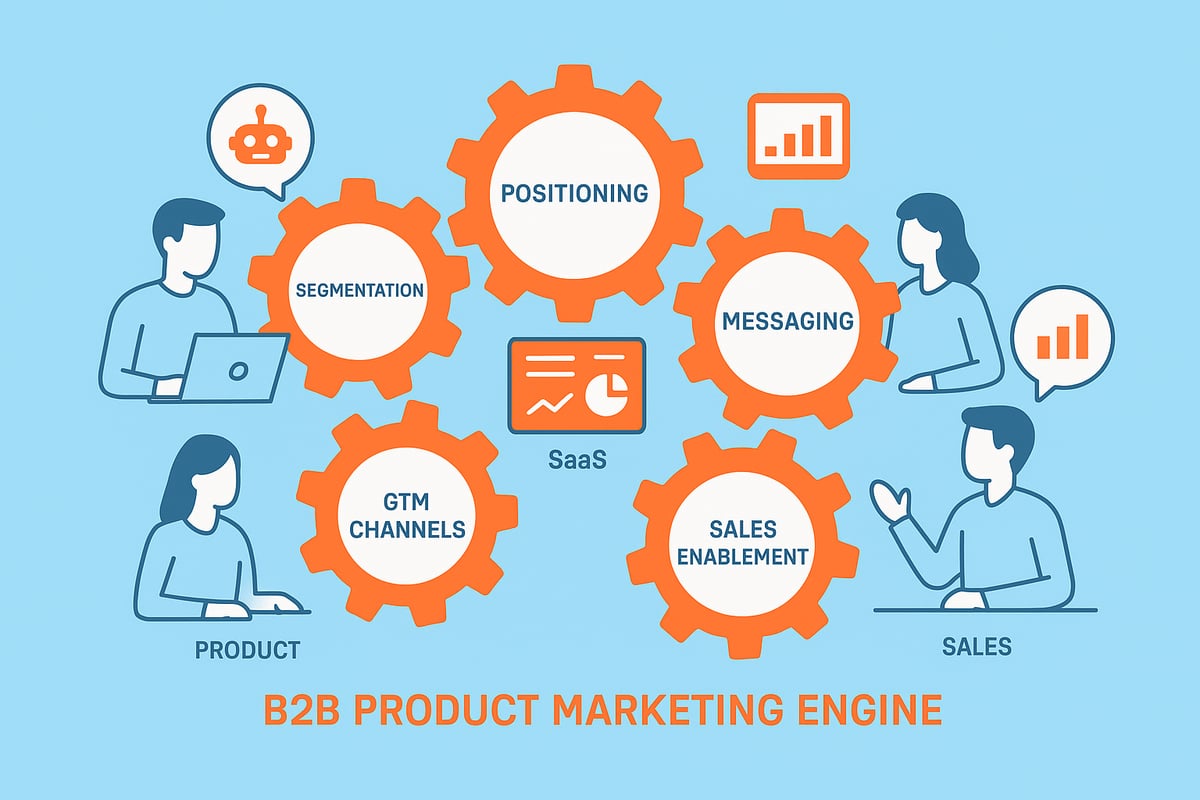
Building a high-performing b2b product marketing engine in 2026 requires a disciplined, tech-enabled approach. Let’s break down the six essential steps that leading SaaS and enterprise teams use to accelerate growth, strengthen alignment, and drive pipeline impact.
Step 1: Define and Validate Your Target Market
Start with precise segmentation using Agentic AI. AI-driven analytics uncover micro-segments and surface evolving enterprise needs faster than manual research. Build dynamic personas that reflect real-world buyer shifts. For example, a SaaS company used AI to spot a rising demand in healthcare compliance, opening a new pipeline channel. This is the foundation of b2b product marketing success.
Step 2: Position Your Product for Differentiation
Identify your unique value proposition by analyzing competitors and listening to your customers. Win/loss analysis powered by AI highlights what resonates. Adjust your positioning to target defensible market niches. When a product team in fintech repositioned with new compliance features, their pipeline grew by 40 percent in one quarter.
Step 3: Align Messaging Across Channels and Teams
Consistency is critical in b2b product marketing. Use AI tools to test messaging across website, email, and sales decks. Optimize in real time based on buyer feedback. Unified messaging builds trust and accelerates deals. Think of it like an orchestra—every instrument (or team) must play in harmony for maximum impact.
Step 4: Select and Optimize GTM Channels
Evaluate every channel—SEO, content, ABM, targeted ads—using pipeline attribution dashboards. Balance inbound and outbound strategies for predictable growth. Top SaaS firms use B2B SaaS marketing strategies to test, iterate, and double down on high-ROI channels. Agentic Automation can orchestrate campaigns across platforms for scale.
Step 5: Enable Sales with Data-Driven Collateral
Equip your sales team with playbooks, objection handlers, and demo scripts tailored to buyer pain points. AI personalizes assets at scale, ensuring every touchpoint is relevant. A cybersecurity SaaS firm saw win rates jump 20 percent after rolling out AI-powered enablement tools.
Step 6: Measure, Iterate, and Scale
Set SMART goals and tie KPIs directly to revenue outcomes. Use analytics and Agentic AI insights to refine campaigns. A unified dashboard keeps everyone aligned. For example, xtype.io boosted pipeline contribution by 60 percent in 12 months through this disciplined, iterative approach to b2b product marketing.
| Step | Key Action | AI Leverage |
|---|---|---|
| 1. Market Validation | Granular segmentation | Agentic AI analytics |
| 2. Positioning | Refine value proposition | Win/loss AI analysis |
| 3. Messaging | Consistent communication | AI message testing |
| 4. GTM Channels | Optimize mix | Pipeline attribution |
| 5. Sales Enablement | Personalized collateral | AI asset creation |
| 6. Measurement | Iterate & scale | Unified dashboards |
With these steps, your b2b product marketing engine will be primed to adapt, differentiate, and scale in a rapidly evolving market.
Leveraging Agentic AI and Automation in B2B Product Marketing
Agentic AI is reshaping b2b product marketing by automating complex workflows and enabling hyper-personalized buyer journeys. These advanced AI systems can autonomously segment audiences, map customer journeys, and deliver real-time personalization across every touchpoint. For a deeper dive into how this technology is transforming the field, see Agentic AI in B2B Marketing.
Key use cases include:
- AI-driven chatbots that qualify leads and answer questions 24/7
- Recommendation engines that surface the right content or product at the right time
- Predictive analytics that forecast pipeline outcomes and optimize campaigns
Agentic Automation empowers teams to orchestrate multi-channel campaigns and scale sales enablement, making b2b product marketing more agile and data-driven. Leading SaaS companies have boosted product adoption rates by over 30% through personalized onboarding powered by Agentic AI.
Best practices:
- Blend AI insights with human creativity for messaging and strategy
- Maintain strict data governance and privacy standards
Common pitfalls:
- Over-automating at the expense of authentic engagement
- Failing to incorporate feedback from sales and customers
To succeed, teams must balance automation with human input, ensuring AI augments—not replaces—strategic decision-making.
Aligning Product, Marketing, and Sales for Unified Growth
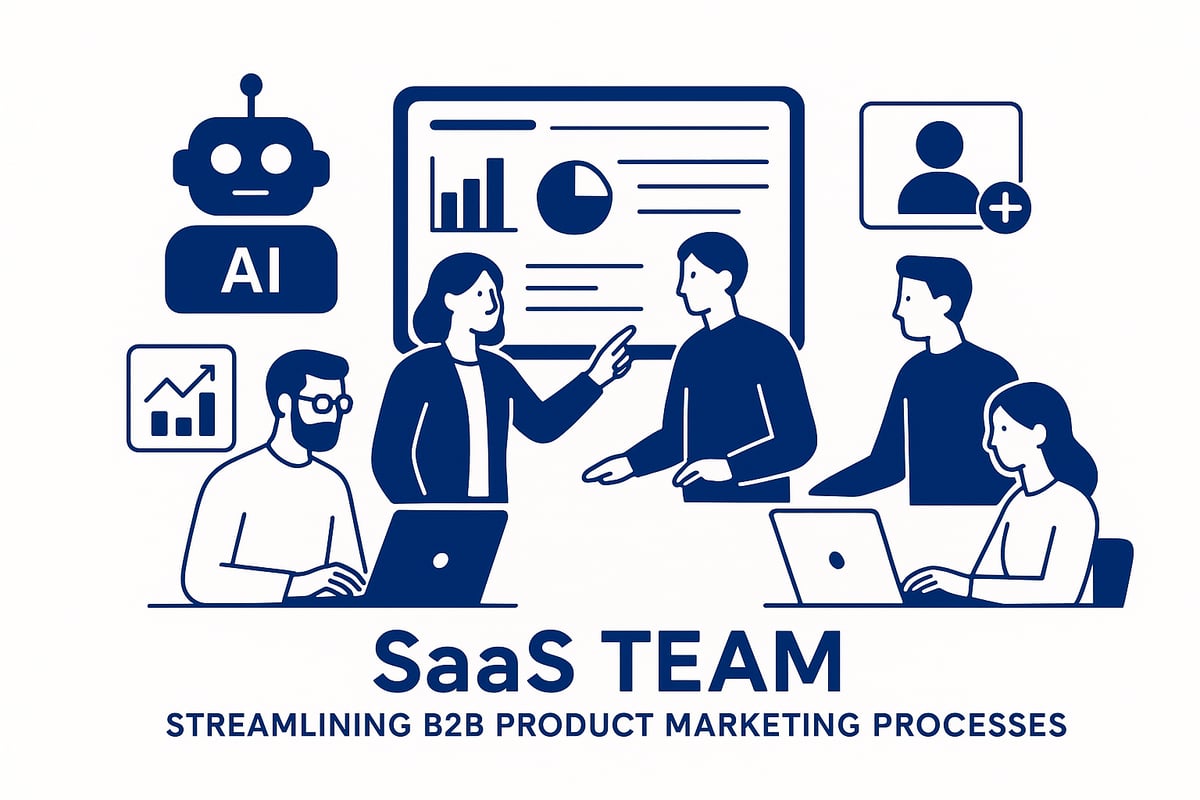
Achieving unified growth in b2b product marketing requires more than just collaboration. In 2026, leading SaaS and enterprise companies treat alignment between product, marketing, and sales as a core growth engine. When these teams operate from a single source of truth, measurable gains in pipeline and ARR follow.
To break down silos, top companies use these actionable tactics:
- Unified dashboards: Real-time analytics and shared KPIs ensure everyone tracks progress toward the same goals.
- Regular GTM councils: Cross-functional meetings drive integrated go-to-market planning and faster decision making.
- Shared enablement resources: Teams co-create sales playbooks, objection handling guides, and messaging frameworks. For practical tips, see Sales enablement content for SaaS.
Hadean’s story illustrates the power of this approach. By repositioning its GTM strategy and aligning teams, Hadean achieved over 300% growth in lead generation in just one year.
Revenue operations (RevOps) now play a pivotal role. RevOps teams manage the full funnel, close feedback loops, and ensure continuous improvement by integrating data from product usage, marketing campaigns, and sales activities.
When product, marketing, and sales share goals, data, and learning, companies build a resilient, scalable engine for growth. This is the new standard for b2b product marketing success in 2026.
Advanced Tactics: Growth Loops, Personalization, and Revenue Operations
To maximize b2b product marketing results in 2026, teams must adopt advanced tactics that drive scalable, sustainable growth. These approaches combine viral loops, deep personalization, and robust revenue operations to fuel pipeline and ARR.
Growth Loops & Virality
Growth loops turn every customer interaction into a potential acquisition channel.
- Launch referral programs to encourage word-of-mouth.
- Promote user-generated content to amplify reach.
- Design in-product features that spark sharing and network effects.
For example, SaaS firms that gamify referrals often see viral signups multiply pipeline growth.
Personalization at Scale
Personalized onboarding and dynamic segmentation are now essential.
- Use AI-driven onboarding flows tailored to each user role.
- Deploy in-app messaging that adapts to buyer behavior.
- Apply Agentic AI to refine segments and deliver hyper-relevant experiences, as discussed in the Agentic Multimodal AI Framework.
This level of personalization increases product adoption and lifetime value.
Revenue Operations & Continuous Innovation
Modern revenue operations unify data, automate reporting, and surface actionable insights.
- Track KPIs across the funnel in real time.
- Automate repetitive tasks to free up teams.
- Enable cross-functional analysis and feedback loops.
Staying ahead in b2b product marketing requires continuous innovation, as highlighted in B2B Marketing Predictions for 2026, ensuring your tactics evolve with market demands.
We’ve covered a lot in this guide—from the fast-changing world of B2B product marketing to how the best SaaS teams align product, marketing, and sales for real growth. Maybe you’re seeing your own story here: the challenge of blending strategy with hands-on execution, or the struggle to turn product fit into repeatable revenue. If you’re ready to see how a unified go-to-market approach can transform your business in 2026, let’s talk about your unique journey and next steps together. Book Your Personal Intro Call and let’s write your next growth chapter.

Latest From
The Blog
Go To Market Strategy Consulting Guide For 2025 Success

Go To Market Strategy McKinsey Guide For Success 2025
.jpg)
Crossing the Enterprise Chasm: A Practical Guide to Sales-Led Growth (SLG)

Let's Build The Future Together
