

GTM Enablement: Build Revenue Engines That Scale



Your CRO just missed quota for the third consecutive quarter. Marketing generated 400 MQLs, but only 12 converted to pipeline. Sales complains about lead quality. Customer success can't articulate the product roadmap to enterprise buyers. This isn't a talent problem. It's a gtm enablement gap that most B2B SaaS companies between $3M and $75M ARR face when scaling across regions.
What GTM Enablement Actually Means
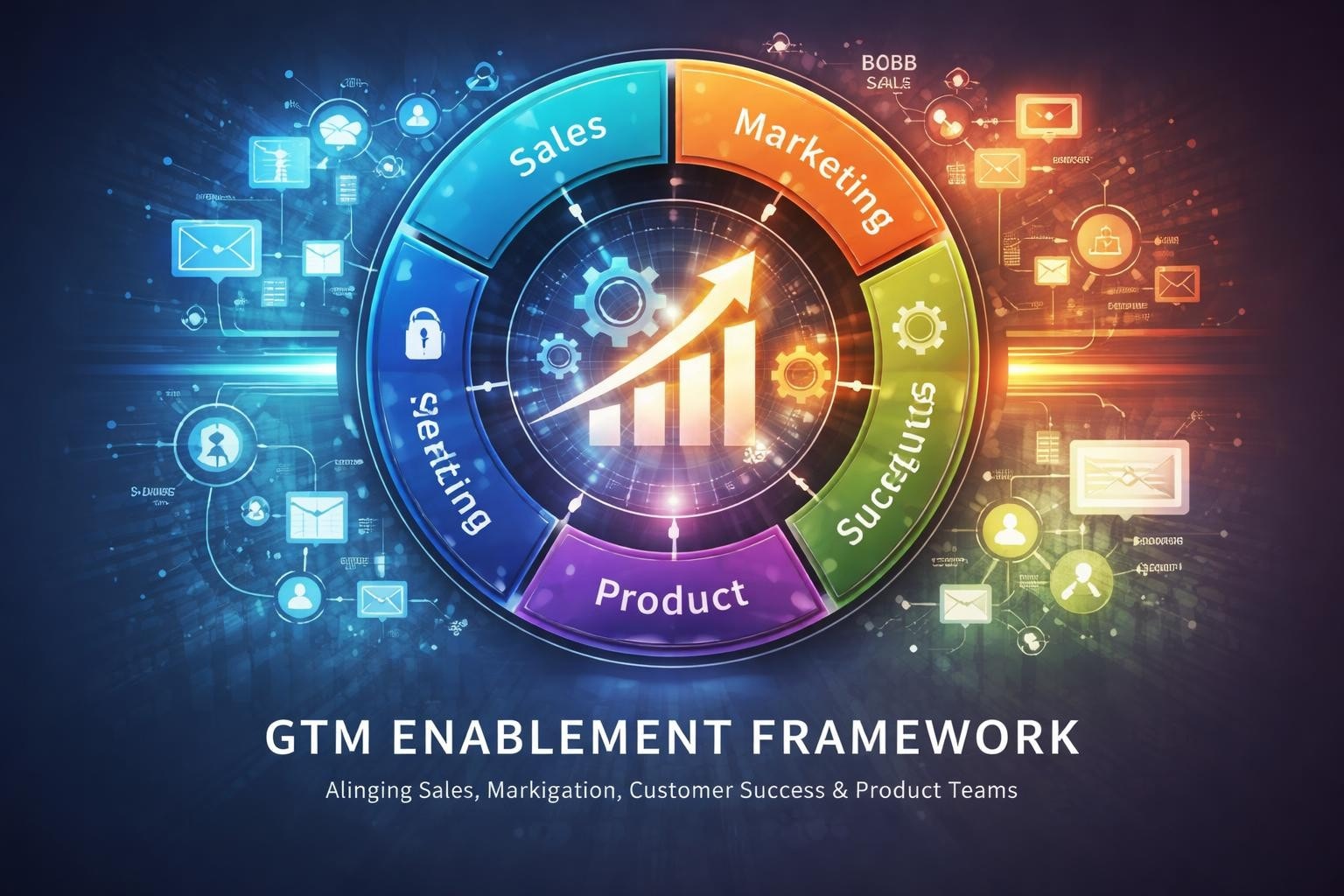
GTM enablement is the operational backbone that equips every customer-facing team with the training, content, systems, and workflows needed to execute your go-to-market strategy consistently. Unlike sales enablement, which focuses narrowly on quota-carrying reps, gtm enablement spans marketing, sales, customer success, product marketing, and solutions engineering.
The difference shows up in metrics. Companies with mature gtm enablement programs achieve 3–5x pipeline coverage versus 1.5–2x for those without structured enablement. Conversion rates from opportunity to closed-won improve by 20–40% when teams operate from shared playbooks and unified messaging.
The Cross-Functional Reality
Most enablement failures stem from organizational silos. Marketing builds battle cards that sales never opens. Product launches happen without customer success training. Regional teams in EMEA and DACH create their own collateral because US-centric materials don't translate.
Fostering cross-functional collaboration requires explicit ownership. Assign a GTM enablement leader who reports directly to the CEO or CRO, not buried three levels down in sales ops. This person orchestrates alignment across functions, not just within one department.

The GTM Enablement Framework That Scales
Effective gtm enablement rests on four pillars: knowledge, content, process, and technology. Each pillar requires deliberate design and continuous reinforcement.
| Pillar | What It Includes | Success Metric |
|---|---|---|
| Knowledge | Product training, competitive intelligence, buyer persona deep-dives, objection handling | Time to productivity for new hires |
| Content | Sales decks, demo scripts, email sequences, case studies, ROI calculators | Content utilization rate across teams |
| Process | Stage-gate criteria, handoff protocols, feedback loops, account planning | Win rate by stage, cycle time |
| Technology | CRM hygiene, enablement platforms, content management, analytics dashboards | Tool adoption rate, data completeness |
Building the Knowledge Foundation
Start with buyer-aligned training, not product features. Your AEs need to articulate business outcomes for CFOs in manufacturing differently than CTOs in fintech. Understanding the customer base drives relevance in discovery conversations.
Create competency matrices for each role. An SDR needs different skills than an enterprise AE or customer success manager. Build progressive training paths that match career stages and complexity of deals.
Regional nuances matter enormously. DACH buyers expect deep technical validation before commercial discussions. US enterprise deals move faster but involve more stakeholders. Your enablement content must reflect these differences, not force a one-size-fits-all approach.
Content Centralization and Deployment
Scattered content kills velocity. When AEs spend 440 hours annually searching for the right asset, you're burning $50K+ per rep in lost selling time.
Centralizing content and tools in a single source of truth eliminates version control chaos. Every rep accesses current messaging, approved case studies, and compliant contracts from one platform.
But centralization without curation creates digital hoarding. Audit your content quarterly:
- Active usage: Remove assets with <5% utilization in 90 days
- Conversion impact: Promote high-performing content, retire low performers
- Stakeholder relevance: Tag content by buyer role, industry, region, deal size
- Format variety: Include videos, one-pagers, interactive tools, not just slide decks
Sales needs different content formats than customer success. An onboarding specialist requires implementation checklists and technical guides. A renewals manager needs ROI validation and expansion playbooks. Design content libraries around use cases, not organizational charts.

Process Design for Execution Consistency
Your gtm enablement strategy fails if it lives in a Notion doc that nobody opens. Process discipline separates companies that scale from those that plateau at $15M ARR.
Define explicit handoff criteria between marketing, sales, and customer success. An MQL becomes an SQL when specific qualification criteria are met, not based on volume quotas or political pressure. Document these thresholds and enforce them in your CRM workflows.
Build feedback loops that close the learning cycle. When deals are lost, capture loss reasons in structured fields. When customers churn, document the root cause. Aligning sales and marketing teams requires shared accountability for pipeline quality, not just quantity.
Regional expansion multiplies process complexity. Your US playbook won't work in EMEA without modification. Create regional runbooks that adapt your core methodology while maintaining strategic consistency. Local teams need autonomy in execution but alignment on objectives and metrics.
The Technology Stack That Enables Scale
GTM enablement without the right technology stack is like running a marathon in flip-flops. Possible, but inefficient and painful.
Your core stack should include:
- CRM platform: Single customer data record across all touchpoints
- Enablement platform: Training delivery, content management, analytics
- Conversation intelligence: Call recording, analysis, coaching insights
- Revenue intelligence: Forecasting, pipeline health, deal risk scoring
- Marketing automation: Campaign execution, lead nurturing, attribution
The technology exists to support process, not replace judgment. Too many companies buy enablement platforms and expect transformation without changing behaviors. Technology amplifies good process but accelerates bad process even faster.
For companies scaling from $3M to $75M ARR, the GTM Assessment & Operating System Design service provides the diagnostic clarity to identify which systems drive leverage and which create technical debt. This assessment reveals where technology gaps constrain growth versus where process or talent issues masquerade as tool problems.

Metrics That Matter for GTM Enablement
What gets measured gets managed. Track these GTM enablement metrics monthly:
- Time to first deal: Days from hire to first closed-won opportunity
- Ramp time to quota: Months until new rep achieves 100% of quota
- Content utilization rate: Percentage of assets accessed in active deals
- Win rate by enablement cohort: Compare trained versus untrained reps
- Pipeline coverage by region: 3–5x coverage indicates healthy enablement
Training teams effectively improves these metrics predictably. Companies that invest 15+ hours per quarter in ongoing enablement see 12–18% higher quota attainment than those with onboarding-only programs.
The most sophisticated metric is revenue per GTM team member. This normalizes for team size and reveals true productivity. Target $1M+ per customer-facing employee at scale. Anything below $600K signals either market issues or execution problems that gtm enablement should address.
Common GTM Enablement Pitfalls
Even experienced operators make predictable mistakes when building enablement programs.
Mistake one: Treating enablement as a sales-only function. Customer success and marketing need structured enablement to execute their parts of the revenue engine. When CS doesn't understand expansion playbooks or marketing can't articulate competitive positioning, the entire GTM motion suffers.
Mistake two: Building content without consumption strategy. Creating 200 slide decks that nobody uses wastes resources. Start with the top 10 scenarios your teams face, nail those assets, then expand systematically based on actual usage data.
Mistake three: Ignoring regional differences. A pricing conversation in Munich differs fundamentally from one in San Francisco. Product-market fit in DACH requires different validation than in the US. Your enablement must account for these cultural and commercial differences.
Mistake four: Launching enablement without executive reinforcement. If your CEO and CRO don't reference enablement content in QBRs and pipeline reviews, the organization won't prioritize it. Leadership must visibly use and reinforce enablement systems.
For PE-backed companies executing rapid expansion, these mistakes compress timelines and inflate costs. Fixing poor enablement under deadline pressure rarely works. Better to invest in robust gtm enablement infrastructure before scaling headcount across multiple regions.
Effective gtm enablement transforms fragmented teams into a coordinated revenue engine that scales predictably across regions and market segments. When knowledge, content, process, and technology align, B2B SaaS companies achieve the pipeline coverage and conversion rates that support sustainable growth. GTM Consult works alongside B2B SaaS leadership teams to build these scalable go-to-market systems, delivering the execution discipline and cross-functional alignment that turns enablement programs from overhead into competitive advantage.

Latest From
The Blog

Go To Market Strategy Consulting Guide For 2025 Success


Go To Market Strategy McKinsey Guide For Success 2025
.jpg)
Crossing the Enterprise Chasm: A Practical Guide to Sales-Led Growth (SLG)

Let's Build The Future Together
