

GTM Systems: Building Scalable Revenue Engines



I watched a PE-backed SaaS CEO stare at his dashboard last month, trying to explain why Q4 pipeline collapsed despite hiring three AEs. The answer wasn't talent or market fit. His company had tactics, not gtm systems. They ran campaigns, made calls, closed deals, but nothing connected into a repeatable engine. Revenue happened to them, not because of them.
Why GTM Systems Beat GTM Strategies
Strategy tells you where to go. Systems get you there reliably.
Most B2B SaaS companies between $3M and $75M ARR have decent strategies. They know their ICP, understand competitive positioning, and can articulate value propositions. But ask them to diagram how a lead becomes pipeline, how marketing and sales interact weekly, or how they forecast accurately across regions, and you get silence.
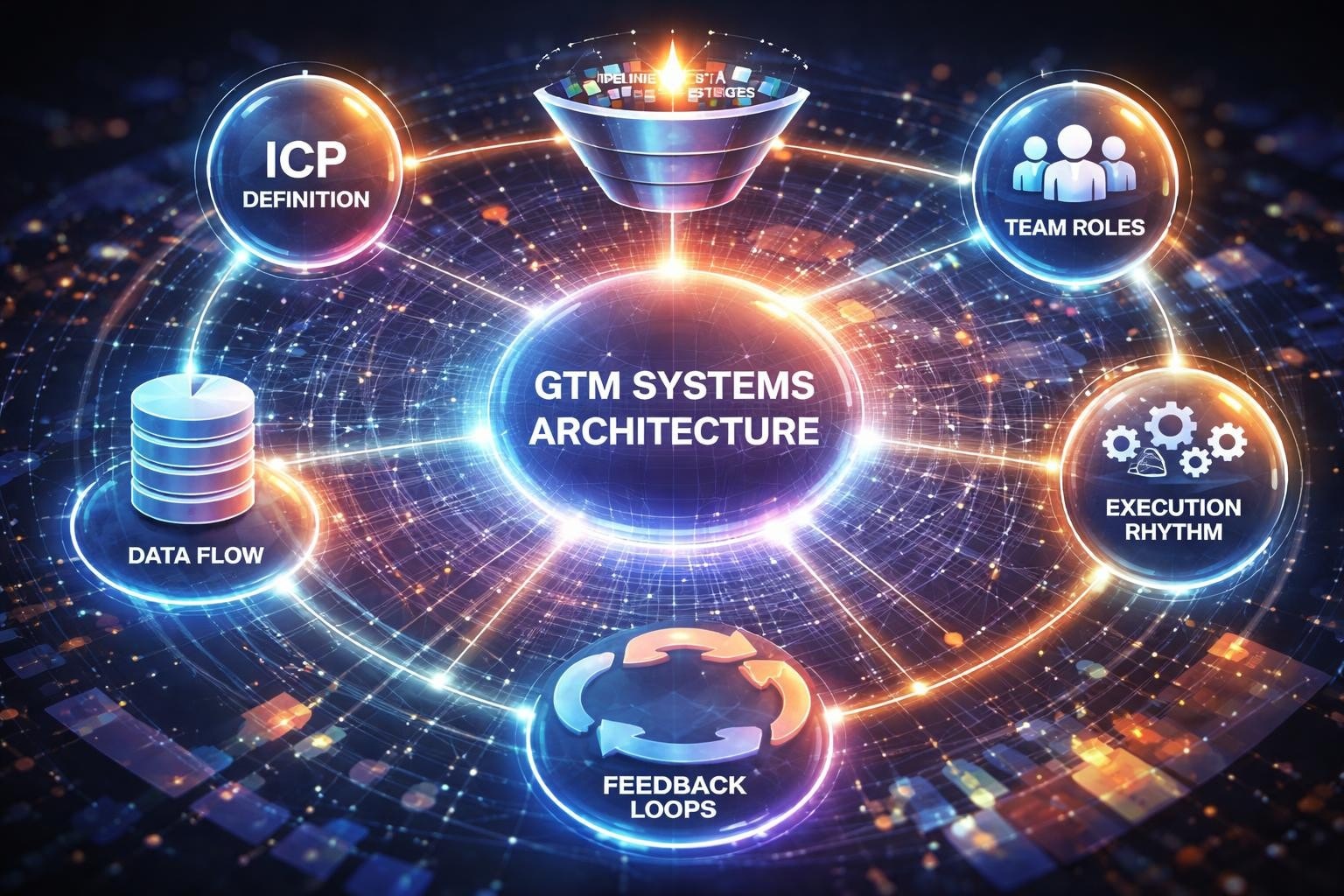
GTM systems are the operating infrastructure that translates strategy into predictable revenue. They define:
- Data architecture and flow between tools
- Team roles, handoffs, and accountability
- Execution rhythm and meeting cadence
- Metrics hierarchies and reporting standards
- Feedback loops for continuous optimization
When Go-to-Market Pros outlines best practices, they emphasize systematic approaches over one-off initiatives. The companies scaling past $50M ARR aren't smarter. They've built systems that compound effort rather than reset every quarter.

The Five-Layer GTM Operating System
I've built and rebuilt gtm systems across 40+ B2B SaaS companies. The ones that deliver 3-5x pipeline coverage share a common architecture.
Layer 1: ICP & Segmentation Engine
Your system starts with precisely defined segments, not vague personas. You need firmographic filters, behavioral signals, and propensity scoring that feeds directly into routing logic.
In EMEA and DACH markets, this gets complex fast. A €10M German Mittelstand company behaves nothing like a €10M UK SaaS startup, even in the same vertical. Your segmentation system must account for regional buying patterns, compliance requirements, and decision-making hierarchies.
Layer 2: Pipeline Architecture
This isn't your CRM stage names. It's the complete flow from signal to closed-won, including:
| Stage | Owner | Entry Criteria | Exit Criteria | Target Velocity |
|---|---|---|---|---|
| MQL | Marketing | Score ≥70, intent signal | SDR accepts | 24 hours |
| SQL | SDR | BANT qualified, meeting booked | AE accepts | 48 hours |
| Stage 1 | AE | Discovery complete | Champion identified | 14 days |
| Stage 2 | AE | Technical validation | Business case built | 21 days |
Every transition needs defined criteria, ownership, and velocity targets. When B2B SaaS lead generation flows through clear stage gates, conversion rates improve 20-40%.
Layer 3: Data & Tool Integration
Marketing automation, CRM, conversation intelligence, product analytics-these tools become gtm systems when they share a common data model and automate handoffs.
The system should automatically:
- Route leads based on segment and geography
- Trigger alerts when accounts hit buying signals
- Update forecasts as deals progress
- Flag at-risk pipeline based on velocity and activity
In cross-regional operations spanning US, EMEA, and DACH, this integration layer handles currency conversion, regional compliance, and localized content delivery without manual intervention.
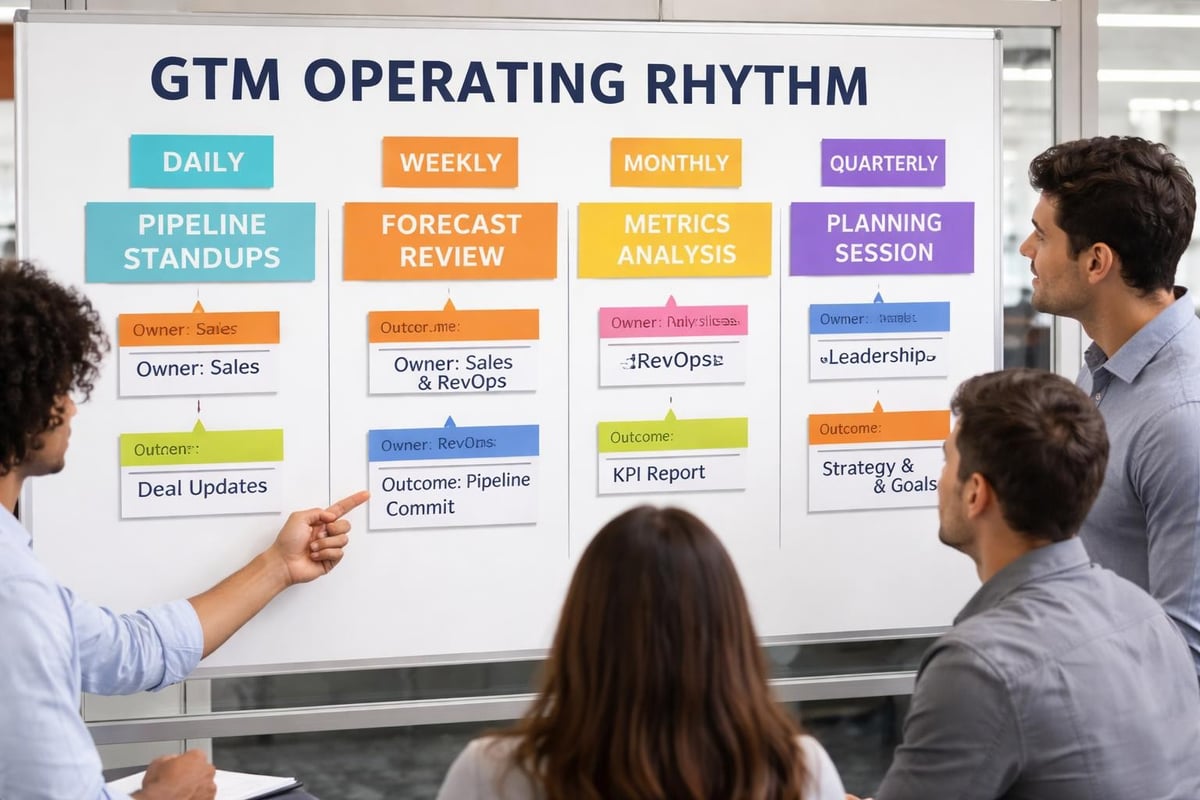
Layer 4: Team Operating Rhythm
Systems require discipline. Your team needs structured cadences:
- Daily standups (10 min) - Pipeline blockers and immediate needs
- Weekly pipeline reviews (60 min) - Deal progression, forecast accuracy
- Monthly business reviews (90 min) - Metrics trends, system optimization
- Quarterly planning (half day) - Capacity modeling, segment prioritization
According to implementation best practices, companies with disciplined operating rhythms see 35% better forecast accuracy than those running ad-hoc meetings.
Layer 5: Metrics & Optimization Framework
The top of your metrics hierarchy should answer one question: Are we building a predictable revenue engine?
Core GTM system metrics:
- Pipeline coverage ratio (target: 3-5x)
- Stage conversion rates by segment
- Velocity by stage and region
- CAC payback period
- Net revenue retention
But gtm systems also need leading indicators. Monitor account engagement scores, content consumption patterns, product usage intensity, and competitive win rates. These signals predict pipeline quality before it shows up in your CRM.
For companies implementing GTM assessment and operating system design, building this metrics layer typically uncovers 20-30% of pipeline that's been misqualified or stuck without visibility.
Sales-Led vs PLG System Design
Your motion dictates system architecture.
Sales-led systems optimize for account coverage, opportunity advancement, and deal velocity. You're managing fewer, larger opportunities with longer cycles. Integration focuses on account intelligence, stakeholder mapping, and competitive positioning.
Product-led systems optimize for activation, expansion, and conversion triggers. You're managing higher volume, smaller ACVs, and usage-based signals. Integration focuses on product analytics, in-app behavior, and automated nurture sequences.
Most companies between $10M and $50M ARR run hybrid motions. Your gtm systems need to support both simultaneously without creating data chaos. That means unified scoring models that weight product usage and sales activity, flexible routing logic, and reports that show the full customer journey.
The GTM marketing strategy must align to your dominant motion while remaining adaptable as you shift emphasis or expand into new segments.
Building Systems That Scale Across Regions
Scaling from US to EMEA to DACH isn't just translation. It's system adaptation.
Your core architecture stays consistent, but regional layers need customization:
- Language and localization - Content libraries, email templates, call scripts
- Compliance and legal - GDPR workflows, data residency, contract templates
- Payment and pricing - Multi-currency, regional discounting, payment terms
- Team structure - Regional SDR/AE coverage models, local marketing resources

Many B2B SaaS companies attempt cross-regional expansion by hiring local sales reps and hoping for the best. Without adapted gtm systems, those reps lack the infrastructure to succeed. GTM Services help companies build region-specific system layers while maintaining global consistency and visibility, ensuring new markets ramp 40% faster than organic expansion typically delivers.

When Your System Is Actually Working
You know your gtm systems are functional when:
- Sales can forecast accurately - Within 10% three months out
- Marketing owns clear pipeline contribution - Not just MQLs, actual closed-won attribution
- New reps ramp in 90 days - The system enables them, not heroic individual effort
- Data flows without manual work - Automated routing, reporting, and alerts
- You can model capacity - Know exactly how many reps you need to hit targets
I've seen go-to-market strategies fail not because of bad positioning or weak messaging, but because companies lacked systems to execute consistently. Your slides look great. Your pipeline stays chaotic.
System Design vs System Execution
Most consultants design systems, hand you documentation, and leave. Your team stares at the blueprint, unsure how to build it while hitting this quarter's number.
Real gtm systems get built in production. You need someone who executes alongside your team, not just advises from the sideline. They configure tools, train teams, run initial processes, and iterate based on what actually works in your specific context.
The difference shows up in time to value. A designed-but-not-executed system might deliver results in 9-12 months. An executed system starts improving pipeline coverage and conversion rates within 60 days.
For PE-backed companies under time pressure to prove out the next value creation lever, that execution speed determines whether GTM becomes your growth driver or another delayed initiative. Understanding what go-to-market means in operational terms, not just strategic concepts, accelerates that timeline significantly.
The System Audit Framework
Before building new gtm systems, audit what exists. Most companies have pieces scattered across tools and teams. Map your current state:
Data Flow Audit
- Where does customer data originate?
- What transformations happen between systems?
- Who owns data quality and hygiene?
- What breaks when someone leaves?
Process Audit
- Document actual workflows (not ideal state)
- Identify manual handoffs and workarounds
- Measure cycle times and conversion rates
- Find bottlenecks causing pipeline stalls
Team Audit
- Who owns what outcomes?
- Where do responsibilities overlap or have gaps?
- What decisions require cross-functional alignment?
- How does information flow during deals?
This audit typically reveals that your biggest GTM constraint isn't headcount or budget. It's system fragmentation that makes every deal feel like the first one.
GTM systems transform revenue operations from art into science, from hero-driven to process-driven, from unpredictable to scalable. Whether you're a founder navigating your first real GTM build or a PE partner demanding systematic value creation, the infrastructure matters more than individual tactics. GTM Consult works alongside B2B SaaS leadership teams to design and execute these systems in production, delivering measurable pipeline improvements within 60 days and building the foundation for predictable cross-regional growth.

Latest From
The Blog

Go To Market Strategy Consulting Guide For 2025 Success


Go To Market Strategy McKinsey Guide For Success 2025
.jpg)
Crossing the Enterprise Chasm: A Practical Guide to Sales-Led Growth (SLG)

Let's Build The Future Together
