

Sales Enablement for B2B SaaS: Build Pipeline That Scales




Your sales team closed 22% of qualified opportunities last quarter. Industry benchmark for your segment is 38%. The gap isn't talent or effort. It's enablement infrastructure. Most B2B SaaS companies between $3M and $75M ARR treat sales enablement as a content library or onboarding checklist. PE partners see this immediately during diligence. Revenue leaders know better: enablement is the connective tissue between product value, market positioning, and repeatable revenue execution.
What Sales Enablement Actually Means in B2B SaaS
Sales enablement is the strategic discipline of equipping revenue teams with the knowledge, content, tools, and processes required to engage buyers effectively at every stage. It's not marketing collateral dumped in a shared drive.
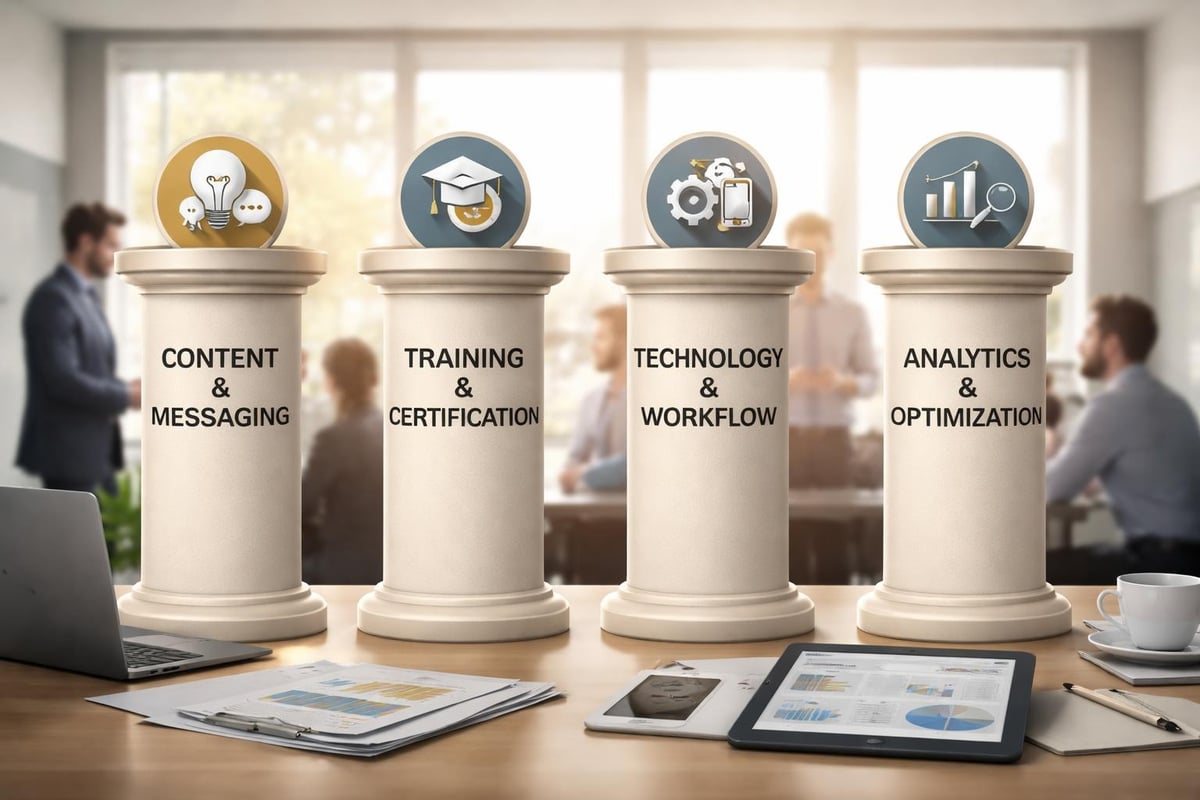
In practice, enablement spans four distinct areas:
- Content & messaging aligned to buyer journey stages and ICPs
- Training & certification on product, competitive positioning, and methodology
- Technology & workflow integration across CRM, sales intelligence, and engagement platforms
- Analytics & optimization measuring content usage, conversion rates, and rep productivity
The companies that scale from $10M to $50M ARR without losing conversion efficiency have built enablement systems, not libraries. They instrument every touchpoint. Salesloft's framework emphasizes this systems approach over ad-hoc content creation.
The Enablement Gap That Kills Pipeline Coverage
Here's the pattern we see across portfolio companies: marketing generates content. Sales ignores 80% of it. Reps build their own decks. Messaging fragments across regions. EMEA tells a different story than the US team. DACH operates independently.
Pipeline suffers because buyers receive inconsistent experiences. Your $45K ACV deal in London hears different value props than your $45K ACV deal in Boston. Both stall at the same stage.
Effective sales enablement solves for consistency without sacrificing regional customization. It standardizes the what (core value drivers, qualification criteria, competitive positioning) while allowing flexibility in the how (language, examples, proof points).
The Sales Enablement Framework for Scalable Revenue
We've deployed this framework across 40+ B2B SaaS companies. It maps enablement assets to buyer journey stages and aligns content creation to conversion bottlenecks.
| Buyer Stage | Enablement Asset Type | Ownership | Update Frequency |
|---|---|---|---|
| Awareness | Industry POV, benchmark data, educational content | Marketing | Quarterly |
| Consideration | Use case decks, ROI calculators, competitive battlecards | Product Marketing | Monthly |
| Evaluation | Demo scripts, technical FAQs, security documentation | Sales + Product | As needed |
| Decision | Business case templates, implementation plans, reference calls | Sales Ops | Quarterly |
The framework works because it assigns clear ownership and refresh cycles. Stale content is worse than no content. A battlecard from 2024 referencing outdated competitor pricing destroys credibility.
Content That Converts vs. Content That Exists
Most sales enablement content fails because it's created in a vacuum. Product marketing builds assets without sales input. Sales requests one-pagers without understanding buyer questions.
High-performing teams instrument content effectiveness:
- Usage metrics: Which decks get opened? Which pages get viewed?
- Conversion correlation: Do deals that receive asset X close at higher rates?
- Rep feedback loops: Quarterly content audits with frontline sellers
- Win/loss integration: What content appeared in closed-won vs. closed-lost cycles?
At GTM Consult, we've seen companies improve win rates by 15–25% simply by killing ineffective content and doubling down on proven assets. Less is more when every piece serves a defined conversion goal.
Building Enablement That Scales Across Regions
Cross-regional enablement presents distinct challenges. Your US-focused value proposition rarely translates directly to EMEA enterprise buyers or DACH mid-market segments. Regulatory considerations, competitive landscapes, and buying committee structures differ significantly.
The mistake is creating entirely separate enablement stacks per region. The smart approach:
- Define global core: Universal value drivers, product capabilities, and qualification frameworks
- Layer regional context: Local case studies, compliance specifics, and competitive nuances
- Enable local customization: Templates and frameworks reps can adapt to specific buyer scenarios
- Centralize metrics: Single source of truth for what's working across all markets

For companies executing a go-to-market strategy across multiple regions, enablement becomes the enforcement mechanism for strategic consistency. It's how you ensure your Berlin AE and your Boston AE deliver equivalent buyer experiences despite cultural and market differences.
The Technology Stack That Supports Enablement at Scale
Enablement infrastructure requires more than a shared drive. Your tech stack should include:
- Content management platform (Highspot, Seismic, Showpad) for centralized asset delivery and analytics
- CRM integration (Salesforce, HubSpot) to surface relevant content at each deal stage
- Sales intelligence tools (LinkedIn Sales Navigator, ZoomInfo) for account research and personalization
- Video and async communication (Loom, Vidyard) for scalable demo delivery and follow-up
- Learning management system (Lessonly, Mindtickle) for certification and ongoing training
The stack matters less than the integration. Reps shouldn't toggle between eight tools to find one case study. Enablement should surface automatically based on deal stage, industry, and opportunity size.
Metrics That Prove Enablement ROI
CFOs and PE operating partners want proof that enablement investment drives revenue outcomes. Track these metrics:
- Time to first deal: How quickly new reps close their first opportunity
- Ramp to quota: Months required to reach 100% of quota attainment
- Content engagement: Asset usage correlated with deal progression
- Win rate by rep tenure: Conversion rates for <6 months vs. 6–12 months vs. 12+ months
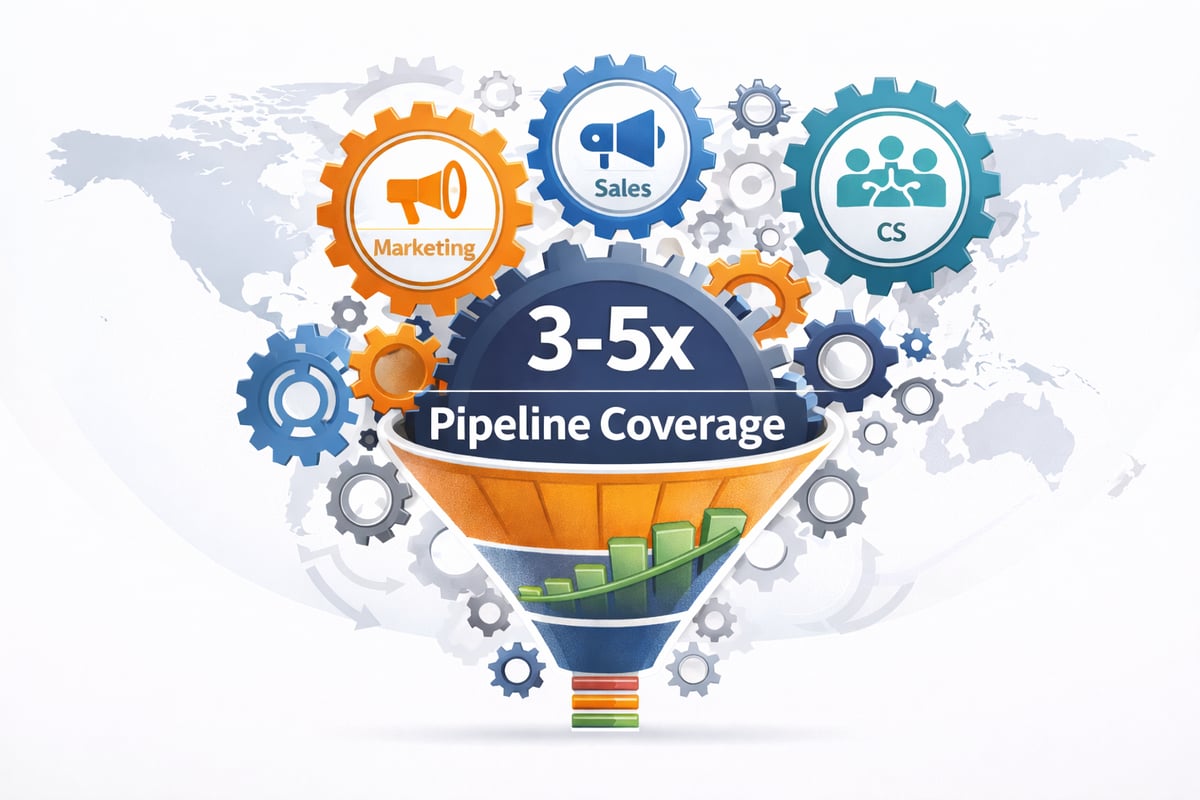
- Pipeline coverage: Ratio of pipeline to quota across the team
Benchmark: Best-in-class B2B SaaS companies achieve 4–5x pipeline coverage and 35–42% win rates on qualified opportunities. If you're significantly below these numbers, enablement gaps are likely contributing factors.
When enablement is working, you see measurable improvements in rep productivity, forecast accuracy, and deal velocity. GTM Consult's services include building these measurement frameworks alongside the enablement infrastructure itself, because execution without instrumentation is just activity.
The Enablement Audit Every Revenue Leader Should Run
Quarter-end is the ideal time to assess enablement effectiveness. Run this diagnostic:
Content audit: What percentage of marketing-created assets were used in closed-won deals last quarter? Which assets appeared in zero opportunities?
Training assessment: Can your newest rep articulate your top three differentiators? Can they run a discovery call without a script?
Process review: How many steps between "rep needs content" and "rep has content"? How many tools do they access daily?
Regional consistency check: Pull three recent demo recordings from each region. Do they tell the same core story?
This audit typically reveals 40–60% of existing content is unused or outdated. It uncovers regional messaging drift. It exposes process friction that adds hours to rep productivity each week.
The companies that scale go-to-market execution run these audits quarterly, not annually. They treat enablement as a living system requiring constant optimization.
From Sales-Led to Product-Led: Enablement Across GTM Motions
Your enablement needs change dramatically as you layer product-led growth onto a sales-led motion. PLG creates self-service users who convert to sales-assisted opportunities at specific inflection points.
Enablement must bridge these motions:
- PQL handoff materials: What sales needs to know about product-qualified leads before first contact
- Expansion playbooks: How to move self-service customers to enterprise plans
- Hybrid demos: Combining product-led trial insights with sales-led value articulation
- Usage-based talking points: Leveraging product analytics in commercial conversations
The evolution from buyer enablement to sales enablement reflects this shift. Modern B2B buyers research independently, trial products without sales involvement, and only engage reps when they're 60–70% through their decision process.
Your enablement strategy must account for this reality. Reps need content that meets informed buyers where they are, not content that assumes zero product knowledge.
Sales enablement separates B2B SaaS companies that scale efficiently from those that add headcount without improving conversion rates. When you instrument content, standardize training, and measure what actually drives deals forward, you transform sales from an art into a repeatable science. GTM Consult builds these enablement systems alongside your team, connecting strategy to execution across US, EMEA, and DACH markets to deliver the 3–5x pipeline coverage and 20–40% higher conversions that turn revenue targets into predictable outcomes.

Latest From
The Blog
Go To Market Strategy Consulting Guide For 2025 Success

Go To Market Strategy McKinsey Guide For Success 2025
.jpg)
Crossing the Enterprise Chasm: A Practical Guide to Sales-Led Growth (SLG)

Let's Build The Future Together
