

B2B SaaS Scaling: The GTM Framework That Actually Works




Most B2B SaaS companies stall between $5M and $15M ARR. The culprit isn't product-market fit or market size. It's the inability to transition from founder-led chaos to a systematic, scalable go-to-market engine. According to recent research on B2B SaaS growth blockers, revenue efficiency issues and monetization challenges represent the primary obstacles preventing companies from achieving their next growth phase. B2B SaaS scaling requires more than ambition-it demands an operating system that turns pipeline coverage into predictable outcomes.
The Critical Inflection Point: When Founder-Led Sales Breaks Down
Between $3M and $10M ARR, you hit the wall. Your founder-led motion that got you here stops working. Deal velocity slows. CAC climbs 40-60% year over year. Your best reps leave because they lack support infrastructure.
This isn't a people problem. It's a systems problem.
Common symptoms include:
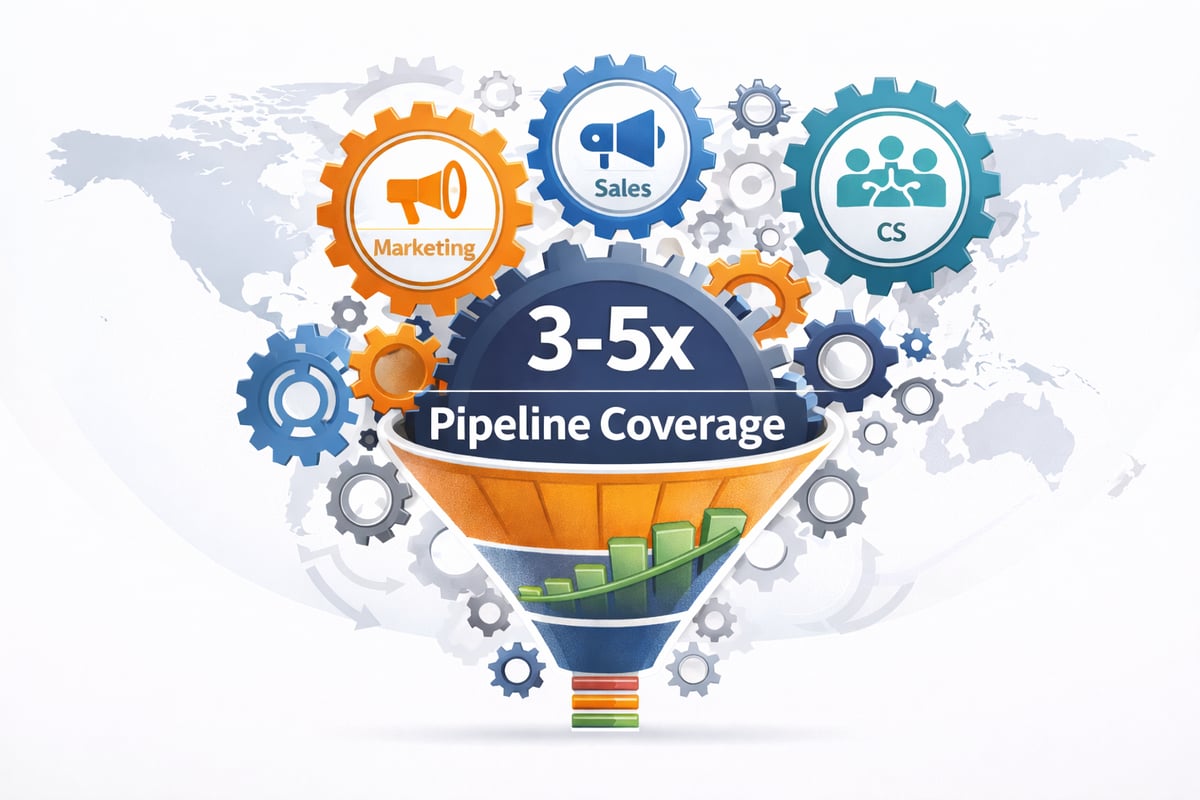
- Pipeline coverage ratios dropping below 3x
- Win rates declining from 30% to 15-18%
- Sales cycles extending by 30-45 days without explanation
- Marketing and sales operating in separate universes
- Regional expansion attempts failing spectacularly
The transition from founder-driven deals to a repeatable go-to-market motion represents the defining challenge of b2b saas scaling. Companies that fail here never reach $25M ARR. Companies that succeed build engines that compound.

Building a Scalable GTM Operating System
A proper GTM operating system isn't a strategy deck. It's the daily machinery that produces pipeline, converts deals, and retains customers across every region you serve. In EMEA, this looks different than in the US. In DACH markets, it requires entirely different positioning and sales methodologies.
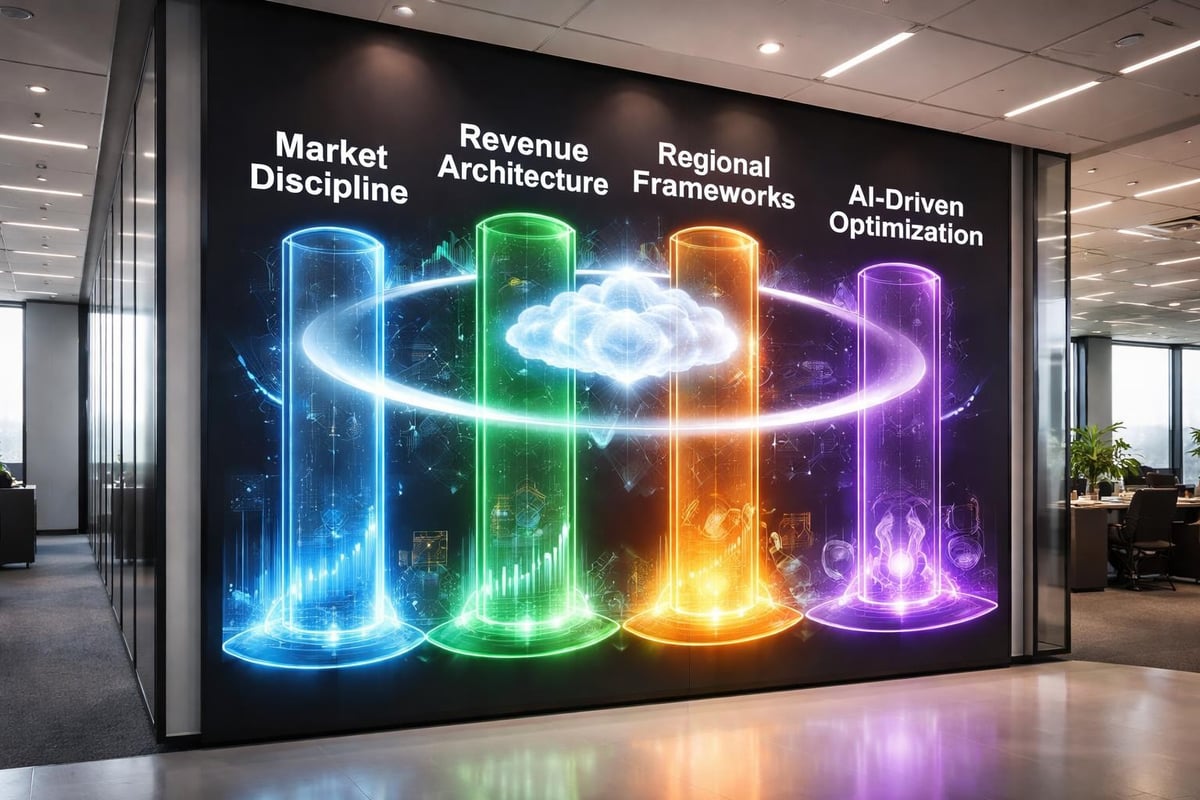
The Four Pillars of B2B SaaS Scaling Infrastructure
1. Market and Segment Discipline
Stop pretending you serve everyone. Define your ICP with surgical precision: company size, tech stack, buyer committee structure, budget cycles. In US markets, you might target 500-2,500 employee companies. In EMEA, those same profiles behave differently due to procurement processes and regulatory requirements.
2. Unified Revenue Architecture
Your sales and marketing teams must share the same definitions, metrics, and compensation structures. When sales and marketing alignment breaks down, you're burning 20-30% of your GTM budget on internal friction rather than customer acquisition.
| Metric | Benchmark (Healthy) | Warning Sign |
|---|---|---|
| Pipeline Coverage | 4-5x | Below 3x |
| MQL to SQL Conversion | 20-25% | Below 15% |
| Sales Cycle (Mid-Market) | 60-90 days | Above 120 days |
| CAC Payback Period | 12-18 months | Above 24 months |
3. Regional Execution Frameworks
B2B SaaS scaling fails when companies copy-paste their US playbook into EMEA or DACH. Each region demands localized messaging, sales methodologies, and partner ecosystems. Your DACH team needs German-speaking SDRs who understand Mittelstand buying behavior. Your EMEA expansion requires navigating GDPR, different sales cultures, and longer evaluation cycles.
4. Metrics Optimization and AI Integration
Traditional dashboards tell you what happened. Modern GTM systems predict what will happen. AI-driven pipeline forecasting, lead scoring optimization, and conversion pattern analysis separate $10M companies from $50M companies. This is where many B2B SaaS companies struggle with reporting infrastructure, lacking the systems to identify growth constraints before they become existential threats.
Sales-Led vs. Product-Led: The False Dichotomy
Here's what PE partners understand that most operators miss: the SLG versus PLG debate is a distraction. Successful b2b saas scaling requires motion orchestration, not motion selection.
Below $10M ARR, you're likely sales-led. You need it to establish enterprise credibility and build case studies. Between $10M and $30M, you layer in product-led mechanics to reduce CAC and accelerate expansion revenue. Above $30M, you run multiple motions simultaneously across different segments and regions.
The Motion Mapping Framework
- Identify your natural motion based on ACV, sales cycle, and technical complexity
- Build excellence in your primary motion before adding secondary approaches
- Layer strategically as you cross $15M ARR, using PLG for SMB and expansion, SLG for enterprise
- Orchestrate handoffs between motions with surgical precision
Companies attempting to run both motions simultaneously before achieving mastery in either typically see 35-50% higher CAC with no improvement in win rates or expansion metrics. The challenges in B2B SaaS sales compound when you lack strategic clarity around motion prioritization and execution discipline.
The Execution Gap: Why Strategy Doesn't Equal Results
Most B2B SaaS companies don't lack strategy. They lack execution systems. Your board deck has beautiful slides about TAM expansion and multi-product strategy. But your frontline managers can't tell you why 60% of pipeline dies in stage 3.
The GTM execution checklist for $3M-$75M ARR companies:
- Weekly pipeline inspection cadence with stage-specific conversion analysis
- Documented playbooks for every deal stage and objection pattern
- Win/loss analysis process that feeds back into positioning and messaging
- Monthly cross-functional GTM reviews with marketing, sales, CS, and product
- Regional performance tracking with market-specific benchmarks
- AI-enabled forecasting that accounts for seasonal patterns and regional variations
This is where fractional CMO and interim GTM leadership delivers measurable impact. Companies lack the internal expertise to build these systems while simultaneously running daily operations. Bringing in operators who've scaled multiple B2B SaaS companies through these exact inflection points accelerates time to systematic growth by 6-12 months.
Cross-Regional Expansion: The $10M to $30M Accelerator
Once you've established systematic growth in your home market, regional expansion becomes your primary scaling lever. But cross-region GTM strategies require different approaches than domestic market penetration.
US Market Expansion
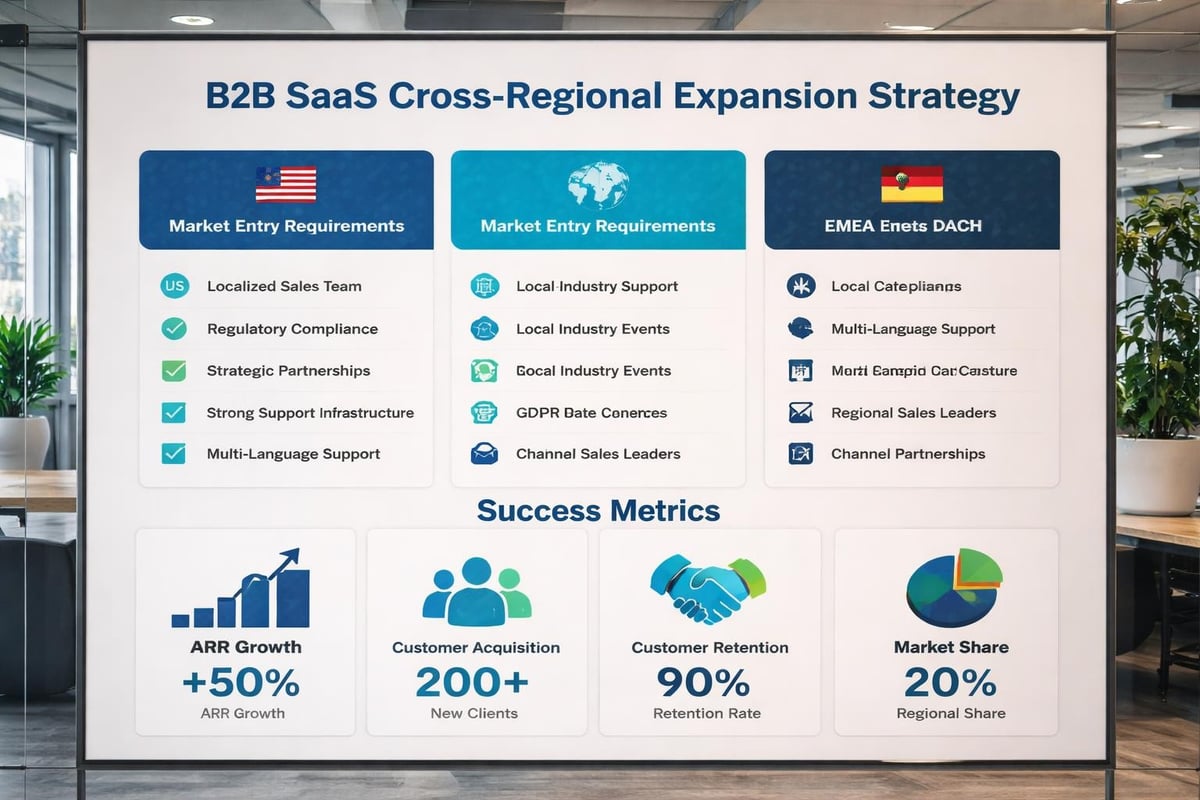
High velocity, digital-first buying, shorter evaluation cycles. Your US expansion needs strong content marketing, aggressive SDR outreach, and partnership leverage. Expect 60-90 day sales cycles for mid-market deals.
EMEA Market Characteristics
Longer sales cycles (90-150 days), relationship-driven buying committees, strong preference for local presence. Your EMEA strategy requires regional team members, localized case studies, and patience with procurement processes that US companies find frustrating.
DACH-Specific Requirements
German precision expectations, deep technical evaluation, preference for on-premise or hybrid deployment options. Success in DACH markets demands German-speaking teams, references from recognized German brands, and willingness to customize your deployment model.
Each region should contribute 25-35% pipeline growth independently while maintaining similar CAC efficiency to your home market within 18 months of entry.
The Metrics That Actually Matter
Vanity metrics kill B2B SaaS companies. MQLs, demo requests, and email open rates don't pay the bills. Focus on the metrics that predict revenue 90 days forward.
Essential GTM metrics for b2b saas scaling:
| Category | Metric | Target |
|---|---|---|
| Pipeline Health | 3-month forward coverage | 4-5x quota |
| Conversion Efficiency | Stage 2 to Close | 25-30% |
| Customer Economics | CAC Payback | 12-18 months |
| Expansion Potential | Net Revenue Retention | 110-120% |
| Regional Performance | Pipeline per rep by region | Within 20% variance |
Companies at $3M-$75M ARR that track these metrics weekly and adjust execution based on trends grow 40-60% faster than competitors who rely on monthly reporting cycles and gut instinct. The discipline of systematic GTM assessment separates predictable growth from hopeful projections.
B2B SaaS scaling isn't mysterious-it's methodical. Companies that build systematic GTM operating systems, execute with regional precision, and optimize based on real metrics consistently outperform their peers. If you're leading a B2B SaaS company between $3M and $75M ARR and need to transform inconsistent growth into a predictable revenue engine, GTM Consult delivers the frameworks, execution discipline, and hands-on leadership that turns GTM complexity into competitive advantage across US, EMEA, and DACH markets.

Latest From
The Blog
Go To Market Strategy Consulting Guide For 2025 Success

Go To Market Strategy McKinsey Guide For Success 2025
.jpg)
Crossing the Enterprise Chasm: A Practical Guide to Sales-Led Growth (SLG)

Let's Build The Future Together
