

GTM Playbook: Build a Scalable Revenue Engine in 2026



Your pipeline grew 40% last quarter, but your conversion rates dropped 15%. Sales blames marketing for unqualified leads. Marketing points to a broken handoff process. Meanwhile, your CAC climbed above $12K while ACV stayed flat at $24K. This isn't a people problem. It's a gtm playbook problem. Most B2B SaaS companies between $3M and $75M ARR operate without a documented, repeatable system that aligns positioning, process, and execution across regions and segments.
What a GTM Playbook Actually Covers
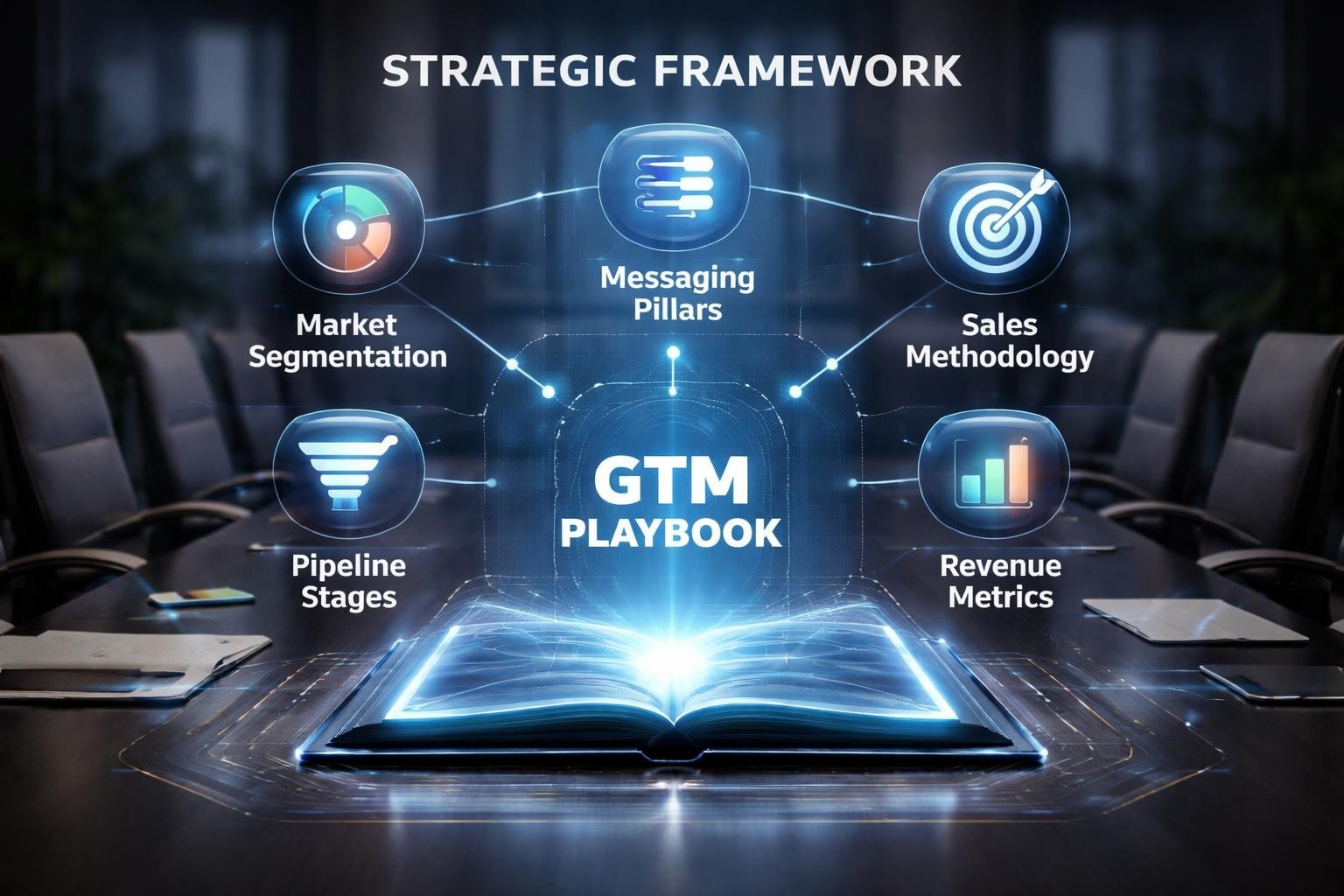
A gtm playbook isn't a slide deck or strategic memo. It's an operational blueprint that defines how you identify buyers, position value, generate pipeline, close deals, and expand accounts across every segment and geography you serve.
The core components of an effective playbook include ICP definitions with firmographic and behavioral triggers, value propositions mapped to buyer personas, channel strategy with budget allocation, pipeline stages with exit criteria, sales methodology and talk tracks, marketing campaign frameworks, and success metrics with accountability.
Without this foundation, you get inconsistent messaging in EMEA versus US markets, reps improvising discovery calls, and marketing campaigns that generate MQLs but not pipeline.
The Four Pillars Every Playbook Needs
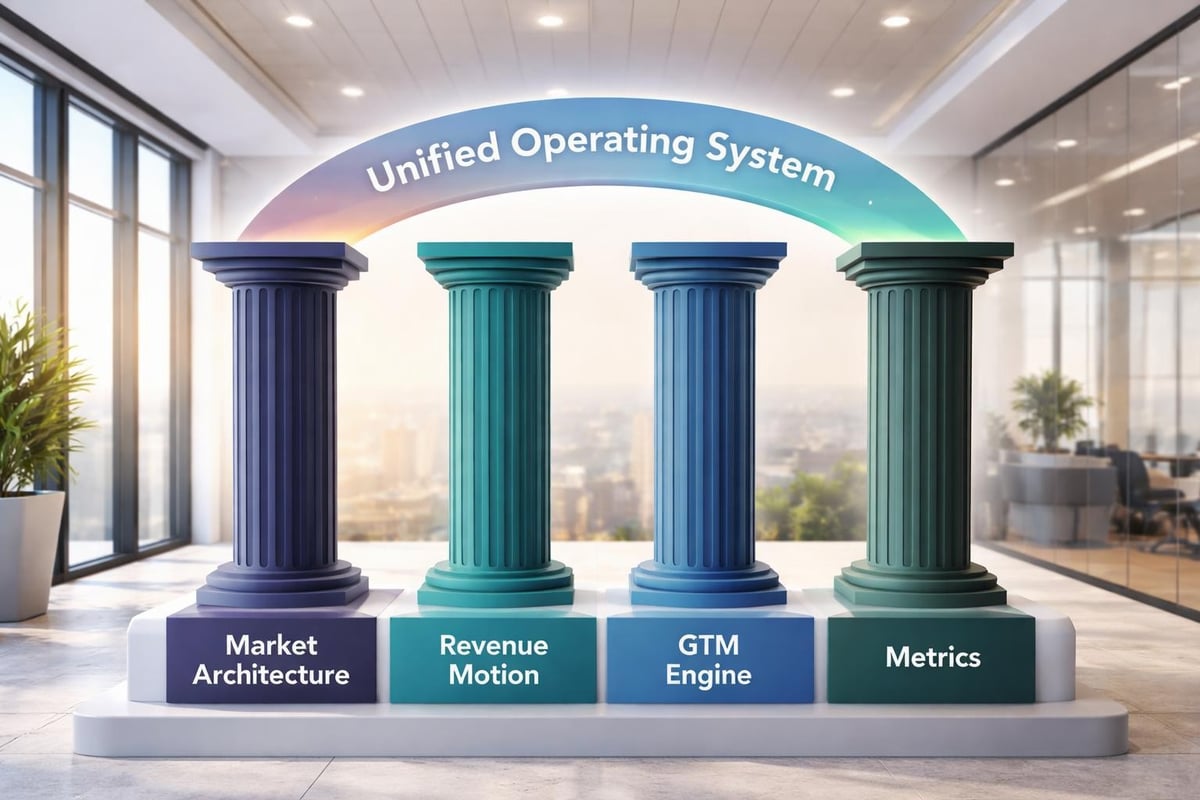
Your gtm playbook must document four interconnected systems that create predictable revenue growth.
| Pillar | What It Defines | Key Outputs |
|---|---|---|
| Market Architecture | Segments, personas, TAM sizing | ICP criteria, buyer journey maps, competitive battlecards |
| Revenue Motion | How you acquire and expand customers | Sales process, PLG funnel, expansion playbooks |
| Go-to-Market Engine | Channel strategy and resource allocation | Campaign calendar, budget splits, team structure |
| Metrics & Optimization | What you measure and how you improve | Pipeline coverage, conversion rates, CAC:LTV ratios |
These pillars connect into a single operating system. When you align sales and marketing execution around documented processes, conversion rates improve 20-40% within two quarters.
Building Your Playbook: The 90-Day Framework
Most executives confuse strategy documents with operational playbooks. A strategy deck explains why you're targeting mid-market fintech. Your playbook explains how a BDR qualifies a $50K opportunity in that segment on day three of their tenure.
Start with your highest-performing segment. Document the exact process that converts prospects to customers at your best rates. Break down the buyer journey into discrete stages with clear entry and exit criteria.
Sales-Led GTM Playbook Components
For companies running sales-led motions, your playbook needs extreme specificity:
- Qualification criteria: Revenue range, tech stack signals, buying committee structure, budget cycle timing
- Discovery framework: Required questions, pain point mapping, technical requirements gathering
- Demo methodology: Customization rules, feature prioritization by persona, objection handling
- Proposal standards: Pricing tiers, discount authority, contract terms, security requirements
- Champion development: Executive alignment tactics, multi-threading approach, decision criteria validation
The best B2B SaaS sales strategies include recorded call examples, email templates, and Slack room escalation paths. New reps should reach productivity in 45 days, not four months.
Product-Led and Hybrid Considerations
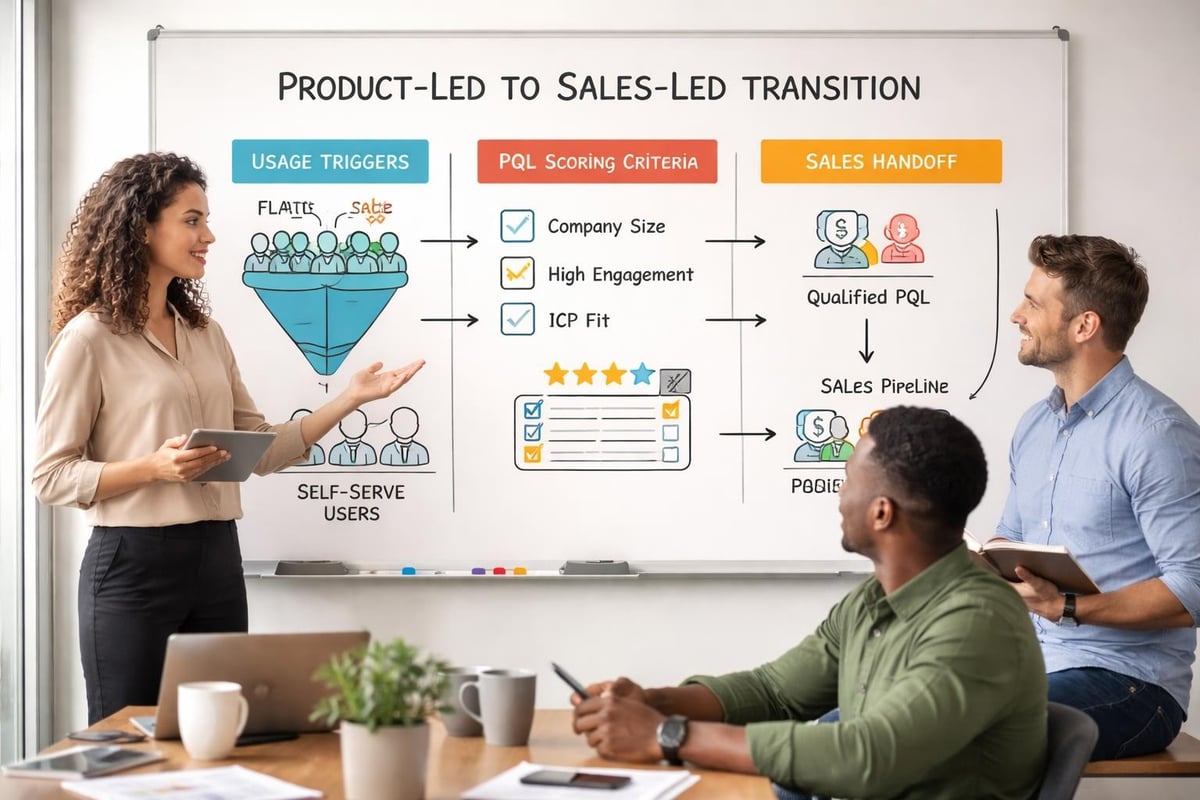
If you're running PLG motion alongside enterprise sales, your gtm playbook must define the handoff thresholds. At what usage level does a self-serve account trigger sales outreach? Which product signals indicate expansion readiness?
Document your activation milestones, conversion triggers from free to paid, and the exact point where product qualified leads (PQLs) enter the sales pipeline. Hybrid models fail when these transition points live in someone's head instead of your playbook.
Regional Expansion and the Playbook Multiplier Effect
Your US playbook won't work in DACH markets without localization. Buyer behavior, contract negotiation norms, procurement processes, and channel preferences vary significantly across regions.
When scaling into EMEA or DACH, your gtm playbook needs regional appendices that document cultural buying patterns, compliance requirements like GDPR implementation, pricing and payment term expectations, and local competitive positioning.
Companies that build proper go-to-market frameworks before expanding reduce their time-to-first-deal by 60% in new geographies. The alternative is burning $300K in the first six months while your regional team figures out what messaging actually resonates.
The Assessment That Reveals Playbook Gaps
Run this diagnostic quarterly. Score each element 1-5 based on documentation quality and adoption:
- ICP definition specificity: Can a new BDR identify qualified accounts without manager input?
- Messaging consistency: Do prospects hear the same value prop from SDRs, AEs, and marketing?
- Process adherence: What percentage of deals follow your documented methodology?
- Onboarding velocity: How quickly do new hires reach 70% of quota?
- Cross-functional alignment: Do product, sales, and marketing reference the same playbook?
Scores below 3.5 indicate you're running on tribal knowledge, not systems. That works until you scale to 50 reps or enter your third region.
Many PE-backed teams discover these gaps during GTM assessment and operating system design engagements, often triggered by missing pipeline targets two quarters in a row despite increased headcount.

Metrics That Make Your Playbook Actionable
Your gtm playbook fails if it doesn't define the metrics that indicate health or breakdown at each funnel stage. Track these benchmarks against your actual performance:
- Pipeline coverage ratio: 3-5x coverage of quarterly quota
- MQL to SQL conversion: 15-25% for sales-led, 8-12% for product-led hybrid
- Opportunity win rate: 25-35% for well-qualified pipeline
- Sales cycle length: 60-90 days for mid-market, 120-180 days for enterprise
- CAC payback period: 12-18 months
When conversion rates drop below these benchmarks, your playbook should trigger specific diagnostic protocols. Is it a lead quality issue? A competitive loss pattern? A stalled deal problem? Don't guess. Build the decision tree into your operating cadence.
The HubSpot GTM kit provides useful templates for tracking these metrics, though most companies need customization for their specific revenue model and segment mix.
Execution Discipline: From Document to System
The graveyard of failed GTM initiatives is filled with beautiful playbooks that nobody used. Implementation requires three non-negotiable elements.
First, embed the playbook into your daily tools. If your methodology lives in a PDF while reps work in Salesforce and Gong, adoption won't happen. Build it into CRM stages, call scripts, and email sequences.
Second, create enforcement mechanisms through pipeline reviews and deal inspections. When deals skip qualification steps, call it out. When reps improvise messaging, correct it immediately.
Third, update the playbook based on win/loss analysis. Your best reps discover new objection handling techniques and competitive differentiators. Capture that intelligence and propagate it across the team through systematic playbook updates.

The Difference Between Generic and High-Performance Playbooks
Generic playbooks describe what to do. High-performance playbooks show exactly how to do it with decision trees, example recordings, and specific talk tracks.
Compare these two qualification approaches:
Generic: "Identify the economic buyer and understand their budget."
High-performance: "Ask: 'Who controls the budget for [category] tools in your org?' If they name someone else, respond: 'That's helpful. How do you typically involve [name] in evaluating new solutions?' Then document the answer in the 'Buying Committee' field and set a task to connect within 48 hours."
The second version eliminates ambiguity. New hires execute it correctly on their first attempt.
Review Product Marketing Playbook resources for positioning frameworks that translate into repeatable sales conversations, especially when launching new features or entering adjacent markets.
Your playbook should reduce variance in execution while allowing experienced reps to adapt tactics based on real-time buyer signals. That balance separates scalable systems from rigid scripts that alienate sophisticated buyers.
A documented gtm playbook transforms revenue generation from an art dependent on individual talent into a repeatable science that scales across teams and regions. The frameworks outlined here provide the foundation, but implementation requires operational expertise and relentless execution discipline. GTM Consult works alongside B2B SaaS leadership teams to build and operationalize these playbooks, driving 3-5x pipeline coverage and 20-40% conversion improvements across US, EMEA, and DACH markets through hands-on fractional CMO leadership and GTM operating system design.

Latest From
The Blog
Go To Market Strategy Consulting Guide For 2025 Success

Go To Market Strategy McKinsey Guide For Success 2025
.jpg)
Crossing the Enterprise Chasm: A Practical Guide to Sales-Led Growth (SLG)

Let's Build The Future Together
