

Guide to Building a Successful Marketing Sales Team in 2026




What will it take to build a high-performing marketing sales team in 2026, when technology, buyer expectations, and competition are evolving faster than ever?
B2B SaaS and enterprise software sales are being transformed by artificial intelligence and Agentic AI, fundamentally reshaping how teams operate, engage buyers, and drive results. Leaders now face new challenges: longer sales cycles, digital-first buyer journeys, and the need for seamless collaboration across every go-to-market function.
This guide is designed to help you build a unified, data-driven marketing sales team that delivers scalable revenue growth. You’ll discover proven strategies for aligning product, marketing, and sales, optimizing team structure, leveraging AI and Agentic Automation, operationalizing data-driven execution, and measuring what matters most.
Ready to future-proof your growth engine? Read on for step-by-step strategies to turn your team into a revenue powerhouse.
Understanding the 2026 Marketing Sales Landscape
Imagine stepping into 2026, where the marketing sales team faces a landscape transformed by rapid advances in AI, Agentic AI, and automation. Teams now operate in a world where go-to-market motions are more data-driven and interconnected than ever.
B2B SaaS buyer journeys have evolved dramatically. Sales cycles are longer, more complex, and almost entirely digital-first. Today’s marketing sales team must adapt to buyers who expect seamless, personalized engagement across every channel. In fact, 80% of B2B buyers demand multi-channel, hyper-personalized experiences, according to Gartner (2025).
Key trends shaping the modern marketing sales team include:
- Proliferation of Agentic AI automating lead qualification and pipeline acceleration
- Greater emphasis on unified product, marketing, and sales functions
- Widespread adoption of remote and hybrid working models, increasing the need for digital collaboration tools
For example, leading SaaS organizations now deploy AI-powered agents to qualify leads and forecast sales outcomes, dramatically improving efficiency. For more on these innovations, review AI in B2B sales strategies for practical insights into how Agentic AI is reshaping GTM execution.
Remote and hybrid teams have become the new normal, prompting companies to reimagine accountability and collaboration. The stakes are high: organizations with aligned GTM strategies are growing revenue 20% faster than their peers, as reported by Forrester (2025). In this environment, building a unified, data-driven marketing sales team is not just a competitive advantage, it is essential for scalable revenue growth.

Step 1: Aligning Product, Marketing, and Sales into One GTM Function
Imagine a marketing sales team where product, marketing, and sales each chase different goals. Leads slip through cracks, campaigns stall, and the pipeline slows. In 2026, this fragmented approach is no longer an option. High-performing SaaS organizations now unite these functions into a single, data-driven growth engine.
A unified GTM model means everyone—product, marketing, and sales—works toward shared objectives, not disconnected KPIs. When a marketing sales team aligns around common goals, handoffs become seamless, and pipeline velocity accelerates. Instead of passing leads from one silo to another, teams collaborate in real time, adapting to changing buyer needs.
How does this look in action? Leading SaaS companies now run joint planning sessions, set cross-functional OKRs, and build agile GTM pods. For example, one scale-up moved from isolated teams to unified pods, increasing customer retention by 36% (DemandScience, 2025). Leadership buy-in is critical. CEOs, CMOs, and CROs must actively champion the alignment, modeling collaboration and accountability.
Weekly pipeline reviews, shared dashboards, and transparent feedback loops keep everyone focused on revenue impact. When teams can see the same data, they can iterate faster and learn from every customer touchpoint. For a deeper dive into structuring and aligning a high-performing GTM function, see Building a go-to-market team.
The result? A marketing sales team that adapts, scales, and delivers measurable revenue growth in the AI-driven B2B landscape.

Step 2: Designing the Modern Marketing Sales Team Structure
Building a future-ready marketing sales team in 2026 means rethinking both structure and culture. As SaaS and enterprise software landscapes evolve, success depends on blending technical expertise with agile, cross-functional collaboration.
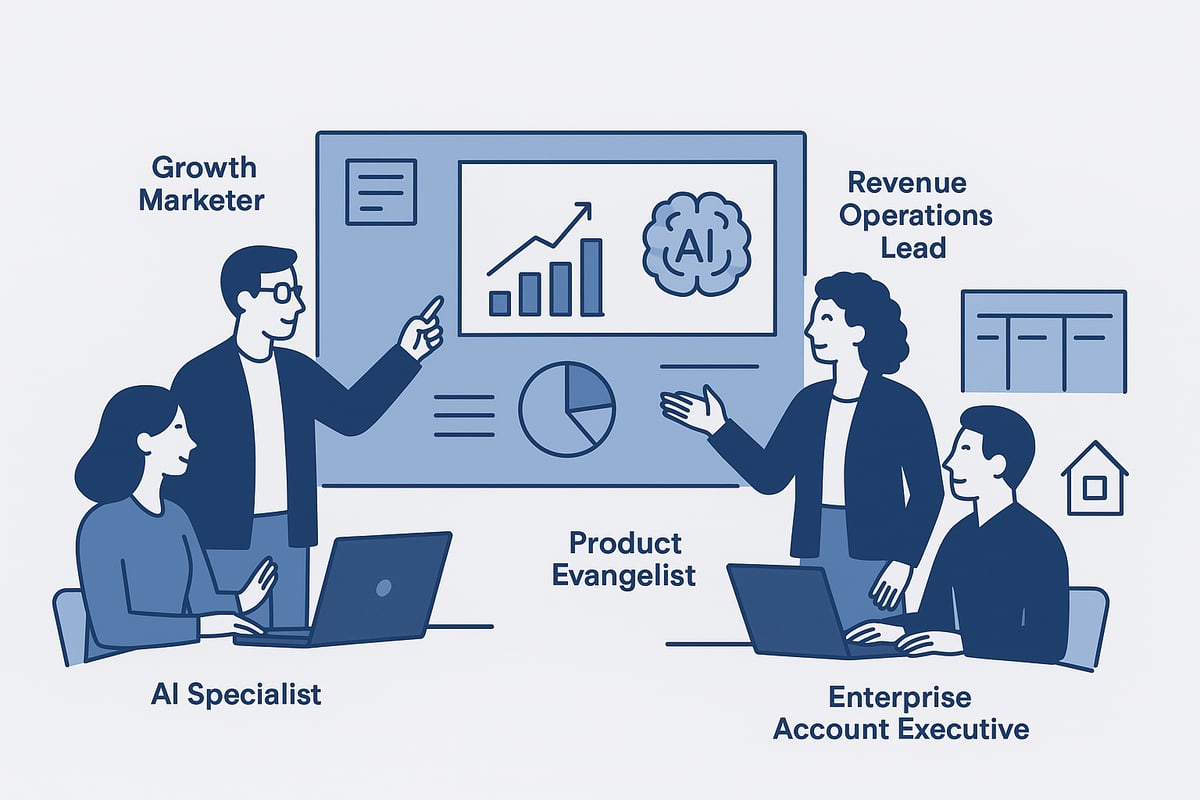
Roles, Skills, and Capabilities for 2026
A high-performing marketing sales team is built on specialized roles, each critical for scalable growth:
- Growth Marketer
- Revenue Operations Lead
- AI/Agentic Automation Specialist
- Product Evangelist
- Enterprise Account Executive
These roles demand data literacy, AI fluency, and the ability to collaborate across functions. Leading SaaS companies now hire hybrid talent who can blend consultative selling with technical knowledge. For more insights on how to structure teams for impact, explore effective marketing team structures.
Continuous upskilling is essential as Agentic AI reshapes go-to-market execution.
Building a Culture of Accountability and Agility
To unlock innovation, a marketing sales team must operate with clear responsibilities and shared KPIs tied to pipeline and ARR. Agile methodologies—such as sprint cycles and rapid experimentation—help teams adapt quickly to buyer needs.
Winning SaaS organizations use agile pods to accelerate GTM initiatives. Psychological safety and open feedback encourage risk-taking and iteration, allowing every marketing sales team member to contribute ideas and learn from outcomes.
Step 3: Integrating AI and Agentic Automation for Scalable Growth
Integrating AI and Agentic Automation is transforming how the modern marketing sales team drives growth in B2B SaaS and enterprise software. Unlike traditional automation, Agentic AI can make autonomous decisions, learn from data, and adapt strategies in real time. This shift empowers teams to move beyond task automation, building a smarter, more agile approach to revenue generation.
Key use cases for Agentic AI in the marketing sales team:
- AI-driven lead scoring and qualification, improving pipeline velocity.
- Hyper-personalized outreach across channels, adapting to buyer signals.
- Predictive pipeline management, forecasting revenue with high accuracy.
- Automated content creation for emails, proposals, and sales assets.
By 2026, 65% of enterprise SaaS companies will deploy Agentic AI in their GTM motions (AI adoption in B2B sales). Leading organizations now use AI agents to handle up to 60% of initial sales qualification, freeing reps to focus on complex deals and deeper relationship building.
This evolution boosts productivity, enhances customer experience, and supports scalable growth. However, challenges remain. Teams must address:
- Change management and team buy-in
- Seamless data integration across platforms
- Maintaining human oversight for quality and compliance
To succeed, a marketing sales team should:
- Select AI tools aligned to their GTM strategy and workflows
- Run pilot programs, then scale proven use cases
- Invest in continuous training and process updates as AI capabilities evolve
Agentic AI is not just a technology upgrade—it is a catalyst for unifying product, marketing, and sales as a single growth engine. The marketing sales team that embraces this change will be positioned for sustainable, measurable success.
Step 4: Enabling Teams with Data-Driven Execution Frameworks
Imagine a marketing sales team drowning in scattered spreadsheets, siloed dashboards, and conflicting reports. In 2026, overcoming this chaos means building a unified data infrastructure where every GTM decision is backed by real-time insights.
Building Unified Data Infrastructure and Reporting
A successful marketing sales team relies on a single source of truth for marketing, sales, and product usage data. Leading SaaS organizations deploy:
- Revenue intelligence platforms
- Unified CRMs
- AI-powered analytics dashboards
These tools break down silos and empower teams to spot trends and bottlenecks instantly. For example, SaaS companies have cut reporting time by 40 percent after moving to unified dashboards, allowing their marketing sales team to shift from manual data pulls to strategic action. Transparent data fuels faster learning, enabling teams to pivot quickly and capture new opportunities.
Operationalizing Playbooks and Enablement
Dynamic GTM playbooks are the blueprint for a high-performing marketing sales team. Regularly updated with real-time feedback, these playbooks cover:
- Buyer personas
- Objection handling strategies
- Competitive positioning
Continuous enablement content—onboarding modules, ongoing training, and deal support—ensures every marketing sales team member stays ahead of market changes. Teams adopting sales enablement content best practices have boosted their win rates by 25 percent, proving that rigorous enablement is not optional but essential for sustainable growth.
How GTM Consult Accelerates GTM Alignment and Revenue Growth
Building a high-performing marketing sales team demands more than great talent. GTM Consult specializes in turning product, marketing, and sales into one unified growth engine for SaaS and tech-driven companies.
GTM Consult delivers:
- Joint GTM strategy sprints that break down silos and align every marketing sales team member to shared objectives.
- Implementation of data-driven frameworks, replacing disconnected KPIs with unified dashboards that reveal real pipeline and ARR impact.
- Hands-on enablement, from onboarding to ongoing deal support, ensuring everyone is equipped for today’s AI-powered, Agentic Automation world.
- Interim leadership and operational best practices to accelerate revenue growth and market entry.
Proven results include:
- 60% pipeline contribution in 12 months for xtype.io
- 300% lead generation growth for Hadean
- Seamless DACH/US market expansion
GTM Consult bridges strategy and execution, empowering the marketing sales team to achieve repeatable, enterprise-grade growth. For more on the business impact of GTM alignment, see GTM alignment and revenue growth.
Step 5: Measuring Success and Iterating for Continuous Improvement
How do you know if your marketing sales team is truly driving scalable growth? In 2026, high-performing teams obsess over measurement, using real-time data to guide every decision and action.
| Metric | Why It Matters |
|---|---|
| Pipeline Velocity | Tracks how quickly deals move from prospect to close |
| ARR Growth | Measures true revenue impact |
| CAC & CLV | Optimizes acquisition costs and lifetime value |
| Marketing-Sourced Revenue | Links campaigns directly to bottom-line results |
Closed-loop reporting is essential. Every activity, from a single email to a full campaign, should be tied to revenue outcomes. Regular reviews—monthly, quarterly, and annually—help identify what's working and what needs to pivot. According to Funnel.io, aligned teams are 67% more effective at closing deals.
Rapid iteration sets leading SaaS organizations apart. Teams that consistently run A/B tests, gather feedback, and tweak strategies often double their conversion rates. For more actionable frameworks, check out these B2B SaaS sales strategy insights.
AI and Agentic AI now play a starring role in performance monitoring and forecasting. Imagine AI agents surfacing real-time pipeline risks, recommending next steps, and even automating reporting. Recent research on AI's impact on sales reveals that teams leveraging Agentic AI consistently outperform their peers in pipeline acceleration and customer retention.
A winning marketing sales team in 2026 fosters a culture of experimentation and learning. Encourage bold ideas, celebrate lessons learned, and make every metric a stepping stone toward continuous improvement.
After exploring how to align your team, leverage AI, and build a truly data driven growth engine, you’re probably thinking about what these changes could look like for your own business. I’ve seen founders and GTM leaders transform disconnected teams into unified powerhouses—watching their pipeline and revenue soar as a result. It’s not just about implementing new tools or frameworks—it’s about creating a culture where everyone’s rowing in the same direction, fueled by insight and accountability. If you’re ready to turn your vision for a 2026 ready sales marketing team into action, let’s chat. Book Your Personal Intro Call

Latest From
The Blog

Go To Market Strategy Consulting Guide For 2025 Success


Go To Market Strategy McKinsey Guide For Success 2025
.jpg)
Crossing the Enterprise Chasm: A Practical Guide to Sales-Led Growth (SLG)

Let's Build The Future Together
