

SaaS and B2B: Building Predictable GTM Revenue Engines




Your SaaS company just crossed $5M ARR. Pipeline feels chaotic. Marketing generates leads that sales ignores. Your EMEA expansion stalled at two enterprise deals. The board wants predictable growth, but your GTM motion runs on spreadsheets and hope. This scenario plays out in 60% of B2B SaaS companies between $3M and $30M ARR, where early traction meets the brutal reality of building scalable go-to-market infrastructure. The intersection of saas and b2b isn't just a category descriptor; it's a strategic discipline that separates companies that plateau from those that scale efficiently across regions and segments.
The Structural Problem: Why SaaS and B2B GTM Breaks at Scale
Most B2B SaaS founders confuse early customer acquisition with repeatable GTM systems. You landed your first 50 customers through founder-led sales, product virality, or channel partnerships. None of these are scalable engines.
The break point arrives when CAC climbs 40–60% while conversion rates drop. Your sales cycle extends from 45 days to 90+ days. Marketing qualified leads pile up with no clear handoff process. EMEA deals require different pricing, longer POCs, and custom contracts your US team can't support.

Here's what benchmark data shows for companies at this stage:
| Metric | Struggling SaaS | Optimized GTM |
|---|---|---|
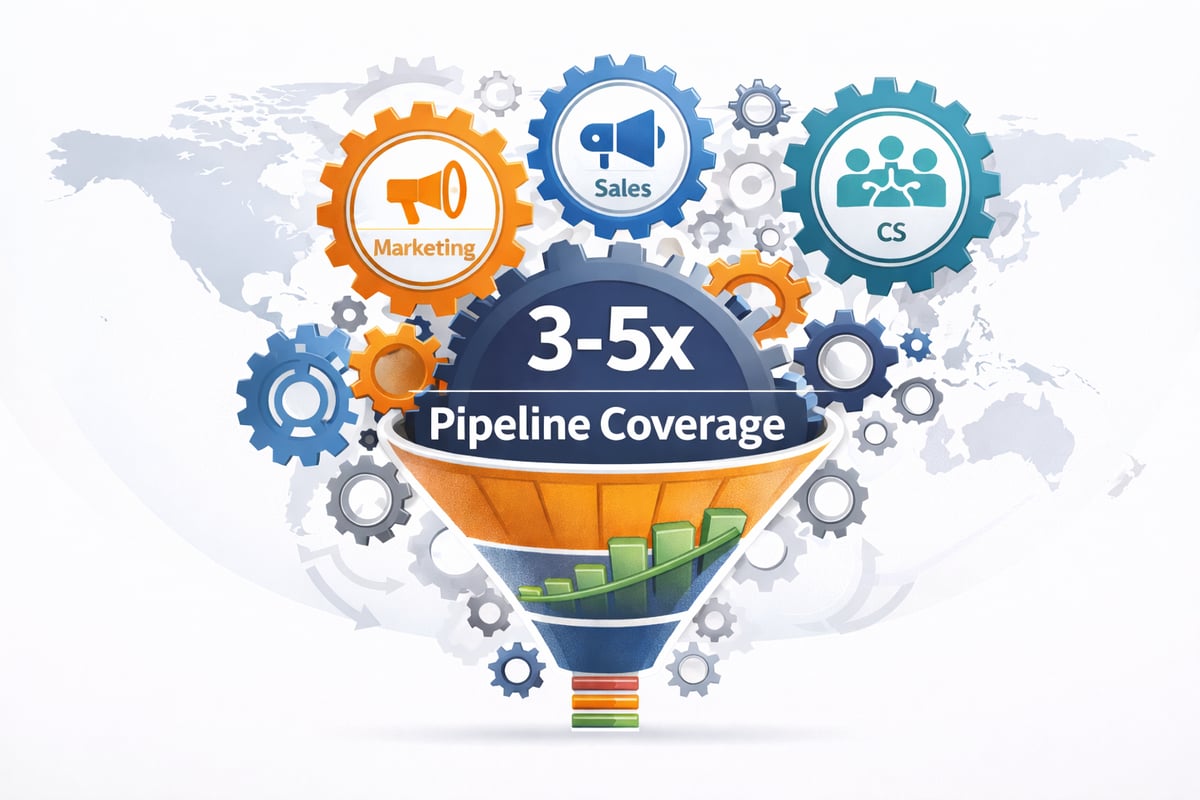
| Pipeline Coverage | 1.5–2x quota | 3–5x quota |
| MQL to SQL Conversion | 8–12% | 20–40% |
| Sales Cycle (days) | 90–120 | 45–75 |
| CAC Payback (months) | 18–24 | 12–16 |
The gap isn't talent or market fit. It's operating system design. Companies that master saas and b2b GTM treat it as a connected system, not isolated functions.
Building the GTM Operating System: Five Critical Components
Scalable B2B SaaS growth requires architectural clarity. Here's the framework PE-backed operators use when auditing GTM infrastructure:
1. Market Segmentation and ICP Precision
Your ICP cannot be "mid-market companies with 100–500 employees." Winning saas and b2b strategies define buyer personas by:
- Budget authority and procurement process
- Technical stack compatibility
- Decision committee structure
- Regional compliance requirements (GDPR, data residency)
- Expansion revenue potential (NDR targets)
DACH buyers require German-language documentation and local payment rails. US enterprise deals demand SOC 2 compliance and multi-year contracts. These aren't sales objections; they're GTM architecture requirements.
2. Pipeline Math and Coverage Discipline
Most SaaS companies run on hope, not math. Calculate your minimum viable pipeline using this formula:
Required Pipeline = (Quarterly Quota ÷ Win Rate) × Pipeline Coverage Multiple
For a $2M quarterly quota with 25% win rate and 4x coverage: you need $32M in qualified pipeline. Not total pipeline. Not marketing touches. Qualified opportunities with budget, authority, need, and timeline.
Your CRM should show this in real-time. If you're manually building pipeline reports in spreadsheets, you don't have a GTM system.

3. Sales-Led vs. Product-Led Motion Alignment
The PLG vs. SLG debate misses the point. Successful saas and b2b companies run hybrid motions with clear handoff triggers:
- Self-serve tier: $0–$5K ACV, product-led onboarding, automated expansion prompts
- Sales-assisted: $5K–$50K ACV, triggered by usage thresholds or feature requests
- Enterprise: $50K+ ACV, dedicated AE from first contact, custom implementation
According to recent B2B SaaS research, companies that optimize content for both buyer-led discovery and sales engagement see 35% higher conversion rates. Your GTM motion should support how buyers want to evaluate solutions, not how you prefer to sell.
4. Regional GTM Adaptation
US, EMEA, and DACH markets aren't just timezone differences. They require distinct GTM approaches:
| Region | Primary Motion | Avg Sales Cycle | Contract Structure |
|---|---|---|---|
| US | Product-led trial → AE close | 45–60 days | Annual prepay |
| EMEA | Consultant-led eval → procurement | 90–120 days | Multi-year, quarterly billing |
| DACH | Enterprise POC → committee approval | 120–180 days | Annual, invoice payment |
Companies that treat EMEA as "Europe sales territory" waste 12–18 months learning these differences through failed deals. Build regional GTM systems from day one, including localized demand generation, legal templates, and customer success playbooks.
5. Metrics That Drive Execution Discipline
PE partners ask for three GTM metrics in every board deck:
- Net Revenue Retention (NRR): Best-in-class B2B SaaS maintains 120%+ NRR
- CAC Ratio: Revenue per new customer divided by fully-loaded CAC (target: 3:1 or better)
- Pipeline Velocity: Average deal value × number of deals × win rate ÷ sales cycle length
These aren't vanity metrics. They're operational controls. When NRR drops below 110%, your product-market fit or customer success process is broken. When CAC ratio falls below 2:1, your GTM efficiency is declining. Fix the system, not the symptoms.
Execution Over Strategy: The Fractional CMO Advantage
Most B2B SaaS companies don't need another strategy deck. They need operators who execute alongside the team. GTM Consult services embed fractional leadership that builds pipeline infrastructure, aligns sales and marketing workflows, and optimizes conversion funnels across regions. This approach delivers measurable improvements in weeks, not quarters, because it focuses on implementation discipline rather than theoretical frameworks.
The difference between a traditional consultant and an embedded GTM operator shows up in deliverables. Consultants provide recommendations. Operators build Salesforce reports, rewrite email sequences, run pipeline reviews, and train AEs on qualification frameworks. For companies scaling from $3M to $30M ARR, this execution gap determines whether you hit growth targets or burn through runway chasing unqualified deals.

The AI and Search Evolution in SaaS and B2B Discovery
Buyer behavior shifted dramatically in 2024–2025. B2B buyers rely heavily on search, but they don't trust vendor content. AI search engines prioritize authoritative sources that demonstrate domain expertise through data, frameworks, and customer outcomes.
Your GTM content strategy needs optimization for both traditional SEO and AI citation engines. This means:
- Publishing benchmark data from your customer base
- Creating frameworks that other operators reference
- Building backlink authority through strategic B2B link-building
- Optimizing for answer engines, not just keyword rankings
Companies like HubSpot win AI visibility by structuring content as authoritative sources. Your GTM system should include content operations that support this shift, especially as 70% of B2B buying committees start with AI-generated research summaries.
Operating System Audit: Your 30-Day GTM Diagnostic
Run this assessment across your GTM functions. Score each dimension 1–5 (1 = broken, 5 = optimized):
Pipeline Infrastructure
- Real-time pipeline coverage visibility by rep and segment
- Automated lead scoring and routing logic
- Stage-specific conversion rate tracking
- Regional pipeline parity (no 80/20 concentration)
Sales-Marketing Alignment
- Documented SLA with lead response times and qualification criteria
- Weekly pipeline generation review with both teams
- Closed-loop reporting on MQL outcome data
- Shared revenue targets, not activity metrics
Regional Execution
- Localized content, pricing, and contracts for each market
- Native-speaking customer success and sales resources
- Market-specific competitive positioning
- Compliance and legal infrastructure
Metrics and Reporting
- Single source of truth for pipeline and revenue data
- Board-ready dashboards with NRR, CAC ratio, pipeline velocity
- Automated alerts for metric degradation
- Attribution model that ties marketing spend to revenue
If you scored below 3 on more than 40% of these dimensions, your GTM system is holding back growth. The good news: these are fixable operational issues, not strategic failures.
Mastering saas and b2b GTM execution requires treating your go-to-market function as an operating system, not a collection of tactics. Companies that build pipeline discipline, regional adaptation, and metrics-driven optimization scale predictably from $3M to $75M+ ARR. If your current GTM infrastructure can't support your growth targets, GTM Consult delivers embedded fractional leadership that builds scalable revenue engines alongside your team, with proven results across US, EMEA, and DACH markets.

Latest From
The Blog

Go To Market Strategy Consulting Guide For 2025 Success


Go To Market Strategy McKinsey Guide For Success 2025
.jpg)
Crossing the Enterprise Chasm: A Practical Guide to Sales-Led Growth (SLG)

Let's Build The Future Together
