

B2B Sales Mastery for SaaS: Metrics, Process & Scale

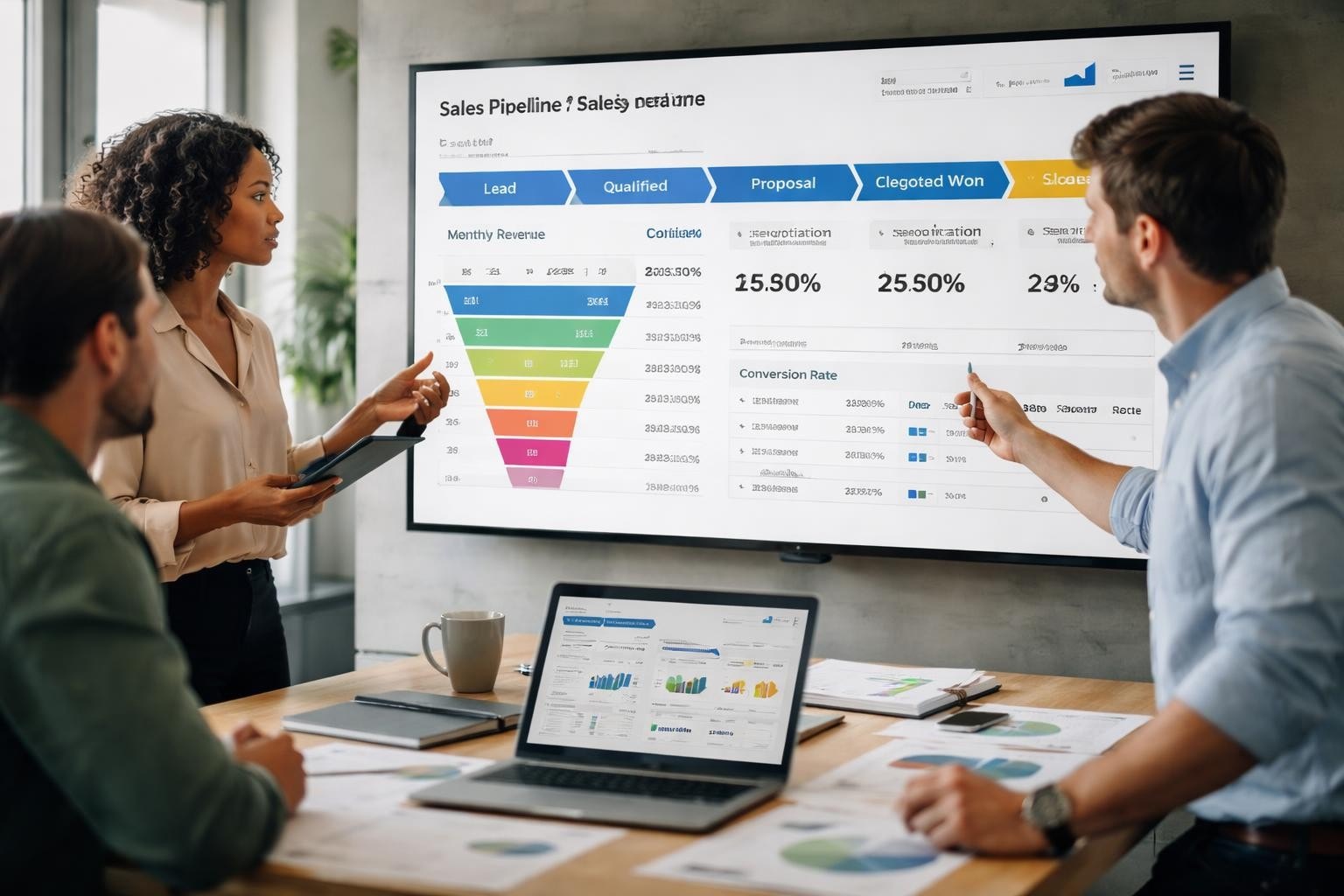


Your pipeline coverage sits at 1.8x and your AE team misses quota three quarters running. The CRO blames marketing, marketing points to sales methodology, and your board wants answers. This isn't a people problem or a product-market fit issue. It's a b2b sales architecture problem, and it's costing you 30-40% of achievable revenue.
The Real Problem: B2B Sales Without Operating Systems
Most B2B SaaS companies between $3M and $75M ARR operate sales like a collection of individual contributors rather than a unified revenue engine. You've hired talented AEs, invested in Salesforce or HubSpot, and copied playbooks from companies three stages ahead of you.
The result? Inconsistent execution, unpredictable forecasts, and growth that stalls the moment you try to scale beyond your founding sales team or expand into new regions.
Here's what separates functional b2b sales teams from revenue engines:
- Defined sales stages with clear exit criteria and conversion benchmarks
- Pipeline coverage ratios tied to deal velocity and close rates by segment
- Execution discipline that doesn't depend on hero sellers
- Cross-functional alignment between SDRs, AEs, CSMs, and product marketing
Without these foundational elements, you're scaling chaos. And chaos doesn't translate across EMEA, DACH, or new market segments where local buying behaviors demand process adaptability, not just effort.
Pipeline Coverage: The Metric That Exposes Everything
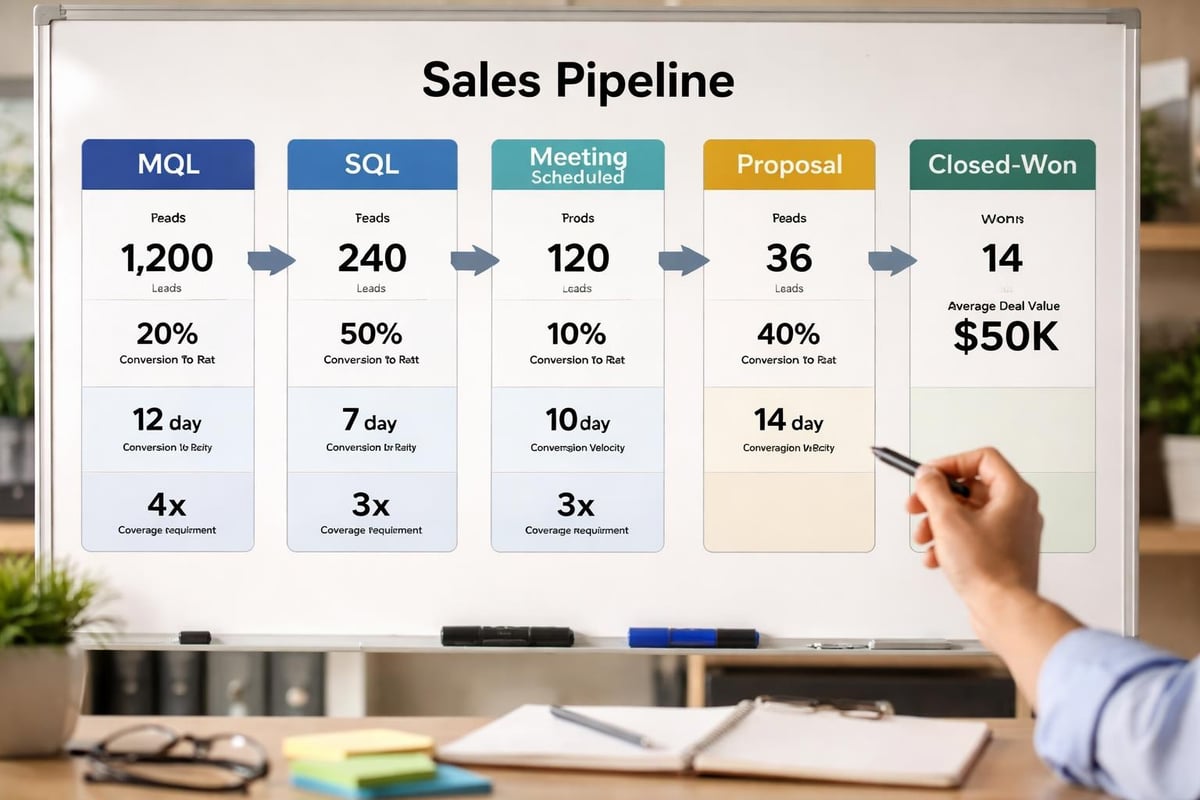
Let's establish the benchmark: healthy b2b sales organizations maintain 3-5x pipeline coverage for their quarterly quota. If your AE carries a $250K quarterly number, they need $750K-$1.25M in qualified pipeline at any given time.
Why the range? Deal velocity and win rates vary by segment, motion, and maturity.
| Segment | Typical Win Rate | Required Coverage | Average Sales Cycle |
|---|---|---|---|
| SMB | 25-30% | 3-3.5x | 30-60 days |
| Mid-Market | 20-25% | 4-5x | 60-90 days |
| Enterprise | 15-20% | 5-6x | 90-180 days |
Most struggling teams discover they're running at 1.5-2.5x coverage because they're counting pipeline that shouldn't exist. Stalled deals from Q2 2025 still sitting in "Proposal Sent." Opportunities created by marketing but never qualified by sales. Expansion deals that CSMs mentioned once but never formalized.
AI adoption in B2B sales is changing how teams manage pipeline hygiene, but technology alone won't fix definitional problems. You need stage criteria that your CRM enforces and your team actually follows.
Sales-Led vs Product-Led: Choosing Your Primary Motion
The PLG versus SLG debate misses the point for most B2B SaaS companies in the $3M-$75M range. You don't choose one motion and abandon the other. You choose a primary motion that drives 60-70% of new ARR, then layer in the secondary motion strategically.
Here's the decision framework:
Sales-Led Growth (SLG) Makes Sense When:
- ACV exceeds $15K-$20K annually
- Buying committees involve 3+ stakeholders
- Implementation requires customization or professional services
- Your ICP includes enterprise or regulated industries
- Expansion revenue depends on executive relationships
Product-Led Growth (PLG) Makes Sense When:
- End users can adopt without procurement approval
- Time-to-value happens in days, not months
- Viral loops exist within customer organizations
- Self-service onboarding creates qualified expansion opportunities
- Your product has clear usage-based pricing triggers
Most companies attempting B2B SaaS scaling fail because they split resources 50/50 between motions instead of establishing a dominant motion with clear metrics ownership. Your sales team can't execute both enterprise field sales and high-velocity inside sales effectively. Choose your primary revenue driver, staff it properly, and build competency before layering complexity.
The Cross-Regional Execution Gap
Expanding b2b sales from US to EMEA or DACH isn't about translation. It's about recognizing that procurement cycles, contract structures, and buyer expectations differ fundamentally across regions.
US markets favor speed and aggressive discounting to accelerate deals. EMEA buyers expect longer evaluation periods and detailed security documentation. DACH markets demand local case studies, references from similar industries, and often prefer annual contracts over multi-year commitments.
Your sales playbook needs regional variants, not a one-size-fits-all approach. This means:
- Objection handling scripts adapted for data privacy concerns (GDPR in EMEA)
- Pricing structures that accommodate different payment terms and VAT considerations
- Demo environments with local language support and region-specific integrations
- Sales engineering resources who understand local compliance requirements
Companies that successfully execute market entry strategies across regions don't simply hire local AEs and hope for the best. They adapt their sales operating system to regional realities while maintaining global metrics standards.

Building Execution Discipline Into Your Sales Team
Execution discipline in b2b sales doesn't mean micromanagement. It means creating systems that make consistent execution easier than ad-hoc approaches.
The Sales Execution Framework:
- Weekly pipeline reviews with standardized aging reports and stage progression analysis
- Deal desk protocols that prevent discounting chaos and margin erosion
- Onboarding sequences that certify AEs on methodology before they touch live pipeline
- Call recording analysis to identify coaching opportunities and replicate top performer behaviors
- Forecast accuracy tracking that holds managers accountable for commit vs. close gaps
When GTM Services work with B2B SaaS companies, the first assessment always reveals the same gap: teams have activity metrics but lack execution metrics. They track calls made and emails sent, but can't tell you stage-to-stage conversion rates or average time-in-stage by segment.

Activity without accountability creates busy sales teams that miss targets. Execution discipline creates predictable revenue engines.
Metrics That Actually Drive B2B Sales Performance
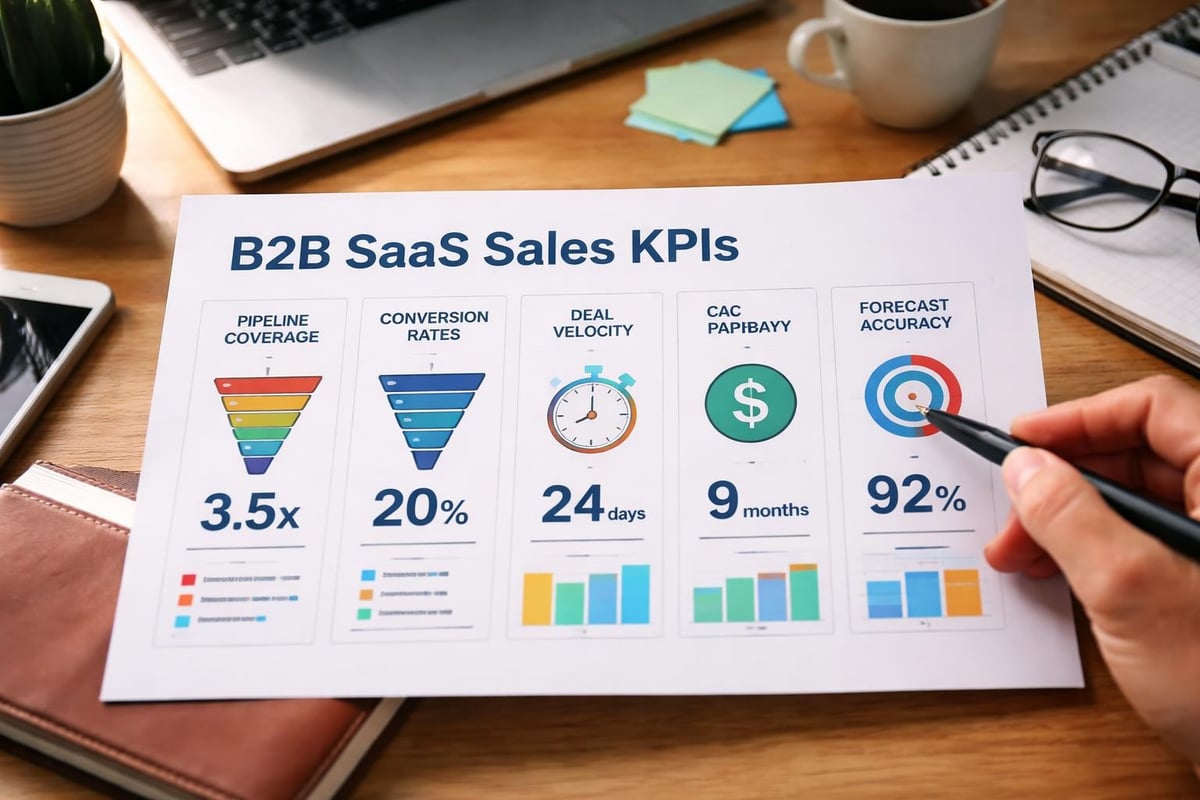
Stop measuring vanity metrics. Start tracking the numbers that predict revenue outcomes 60-90 days in advance.
| Metric | Benchmark | What It Reveals |
|---|---|---|
| Pipeline Coverage | 3-5x quota | Revenue predictability |
| Stage 2 → Stage 3 Conversion | >40% | Qualification effectiveness |
| Average Deal Cycle | <90 days (MM) | Sales efficiency |
| Win Rate (Late Stage) | >30% | Competitive positioning |
| CAC Payback Period | <12 months | Unit economics health |
These metrics matter because they're leading indicators. By the time you're measuring closed-won revenue, you're looking at decisions made 90-180 days ago. The teams that consistently hit targets are obsessing over pipeline generation, qualification standards, and conversion rates today that will determine Q3 and Q4 performance.
Understanding B2B market trends for 2026 reveals that buyers expect faster response times and more personalized outreach, which means your metrics need to include speed-to-lead and personalization quality scores, not just volume.
The Fractional CMO Connection to B2B Sales Success
Here's what most CEOs miss: b2b sales performance problems often originate in marketing. Not because marketing isn't generating leads, but because there's no agreed-upon definition of what constitutes a qualified opportunity.
When marketing leadership operates independently from sales leadership, you get:
- MQLs that sales never touches
- Sales teams building their own outbound lists instead of working marketing pipeline
- Budget fights over attribution when everyone's measuring different things
- Disconnected messaging between what marketing promises and what sales delivers
A Fractional CMO who understands b2b sales mechanics bridges this gap. They establish service-level agreements between teams, implement shared revenue metrics, and ensure that demand generation programs actually feed your sales engine rather than creating reporting theater.
AI and Automation: Tools vs. Transformation
Every vendor promises that AI will transform your B2B sales process. Some of that's true. Most of it's hype wrapped around basic automation.
Where AI actually delivers value in b2b sales:
- Conversation intelligence that surfaces objections and competitive mentions across your entire team's calls
- Predictive lead scoring that identifies which opportunities deserve AE attention
- Email sequencing that personalizes outreach based on prospect behavior and firmographics
- Deal risk analysis that flags stalled opportunities before they age into dead pipeline
Where AI fails without human judgment:
- Complex enterprise negotiations requiring relationship capital
- Consultative discovery that uncovers unarticulated needs
- Custom pricing and contract structures for strategic accounts
- Change management conversations with executive buyers
The companies winning with AI in sales aren't replacing their teams. They're augmenting execution with tools that handle repetitive analysis and free up AEs for high-value interactions. That's the difference between AI transformation and AI theater.
Team Architecture: The Overlooked Sales Multiplier
Your org chart determines your growth ceiling. If you're still running with full-cycle AEs who prospect, demo, close, and manage accounts, you're leaving 40% of potential productivity on the table.
Specialized role architecture for scalable b2b sales:
- SDRs/BDRs: Focus exclusively on outbound prospecting and inbound qualification
- AEs: Own discovery through close for qualified opportunities
- Sales Engineers: Deliver technical validation and solution design
- CSMs: Drive adoption, expansion, and renewal
- Revenue Operations: Manage systems, reporting, and process optimization
This doesn't mean you need to hire five people for every AE role tomorrow. It means acknowledging that GTM team architecture should evolve as you scale from $3M to $10M to $30M ARR.
Early-stage companies need generalists. Growth-stage companies need specialists who can execute their specific function at scale.
B2B sales success at scale requires more than talented sellers and good technology. It demands operating systems that create predictable execution across teams, regions, and market conditions. If your sales organization struggles with inconsistent pipeline coverage, regional expansion challenges, or alignment between sales and marketing, GTM Consult delivers the frameworks and hands-on execution to build revenue engines that scale. We work alongside your team to implement the metrics discipline, process architecture, and cross-functional alignment that turns sales from an art into a science.

Latest From
The Blog

Go To Market Strategy Consulting Guide For 2025 Success


Go To Market Strategy McKinsey Guide For Success 2025
.jpg)
Crossing the Enterprise Chasm: A Practical Guide to Sales-Led Growth (SLG)

Let's Build The Future Together
